


The S&P 500 remains within reach of 8003, but sticky inflation, uneven participation, and a Magnificent 7 still in consolidation are making the next leg higher harder than it looks.
Last week gave the bears another opening.
They had semiconductor weakness, worsening participation, a hawkish Fed message and a sharp jump in short-term yields.
And they still couldn’t roll the market over.
That’s the part I care about.
The S&P 500 gained 0.5%, the Nasdaq Composite rose 0.9%, and the Dow added 0.5%. But the S&P MidCap 400 fell 1.3% and the Russell 2000 declined 1.5%.
The indexes finished higher.
Much of the market underneath them did not.
The week really unfolded in two acts.
Nvidia made it painfully clear that the AI capital-spending boom is still alive.
Then:
Warsh reminded investors that strong growth and sticky inflation come with a price: higher-for-longer rates.
So here we are.
The AI story got better.
The rate backdrop got tougher.
And price is still trapped inside the August range.
Bottom Line
I remain bullish on the longer-term trend.
Short term?
This remains a challenging environment.
Chop and rapid rotation remain the dominant features. Recent winners get sold, recent losers bounce, leadership changes quickly, and the headline indexes often tell a much quieter story than the average stock.
That is not a great environment for swinging harder.
It is an environment for patience, selectivity and better entries.
The good news is that the S&P 500 remains near its highs. Corporate earnings and outlooks remain strong. Nvidia gave investors little reason to think the AI infrastructure cycle is approaching an imminent peak.
And beneath the surface, something potentially important happened: software rallied nearly 6% while semiconductors fell more than 2%, continuing the recent divergence between the two groups.
The AI trade didn’t disappear. The leadership changed.
Semiconductors couldn’t hold Nvidia’s post-earnings momentum.
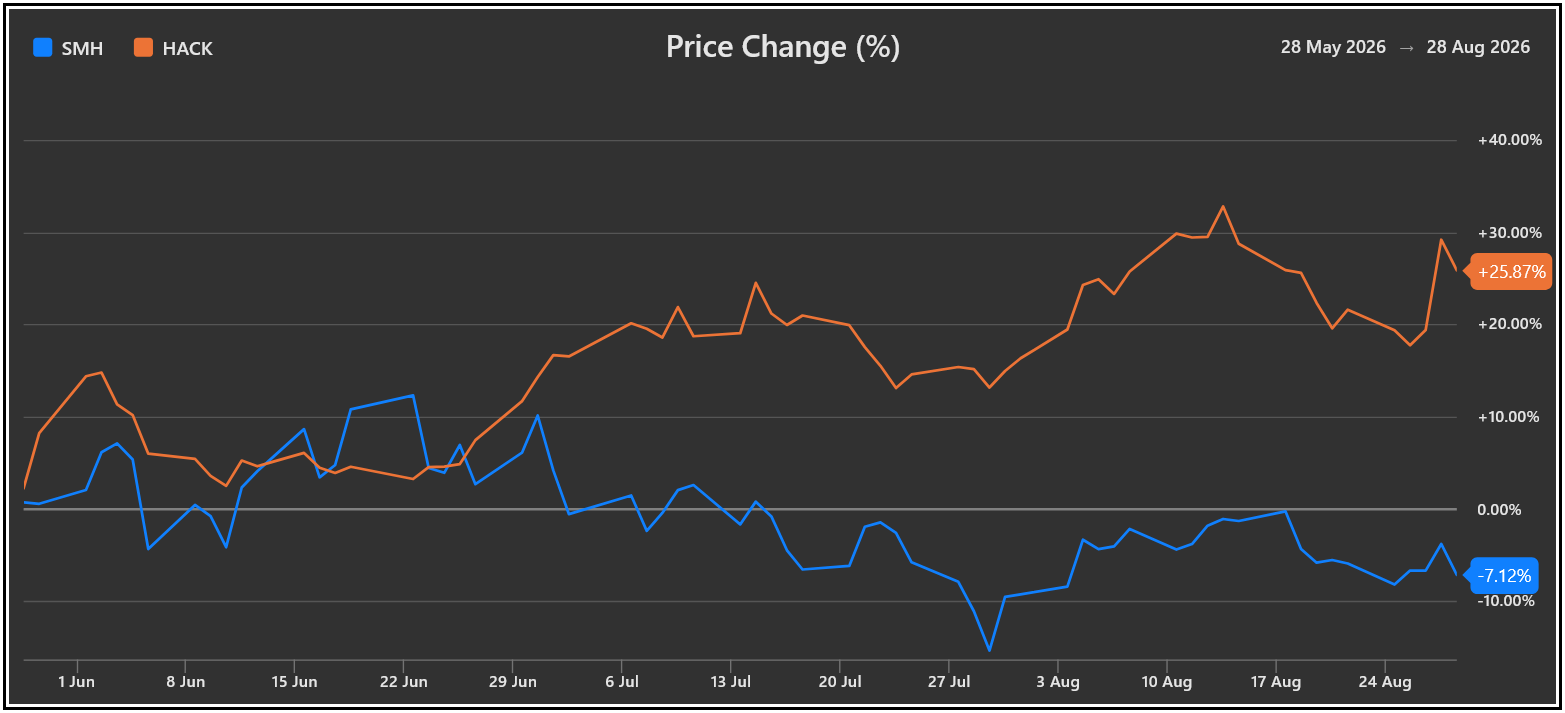
Meanwhile, AI-related areas such as cybersecurity are outperforming, while the Magnificent 7 (MAGS) remain stuck in a consolidation that has now lasted roughly ten months.
At the same time, small caps weakened. Midcaps weakened. Equal-weight participation deteriorated late in the week.
And the Fed just made rates a bigger problem, increasing expectations for another rate hike as early as September.
That is why I am not interested in backing up the truck here or forcing positions.
There are times to do a lot. As a friend suggested, this is a time to do less and wait for the market to make our decisions easier.
Fortunately, the S&P 500 has given us a wonderfully simple map.
August high: 7816
August low: 7638
That is a 178-point trading range.
A breakout of the range targets 7994.
A breakdown targets 7460.
Until price escapes that box, most of what happens inside it is noise.
My approach remains simple:
Find what we want to own.
Know where we want to own it.
Set the alerts.
Then wait for the market to come to us.
What Happened This Week
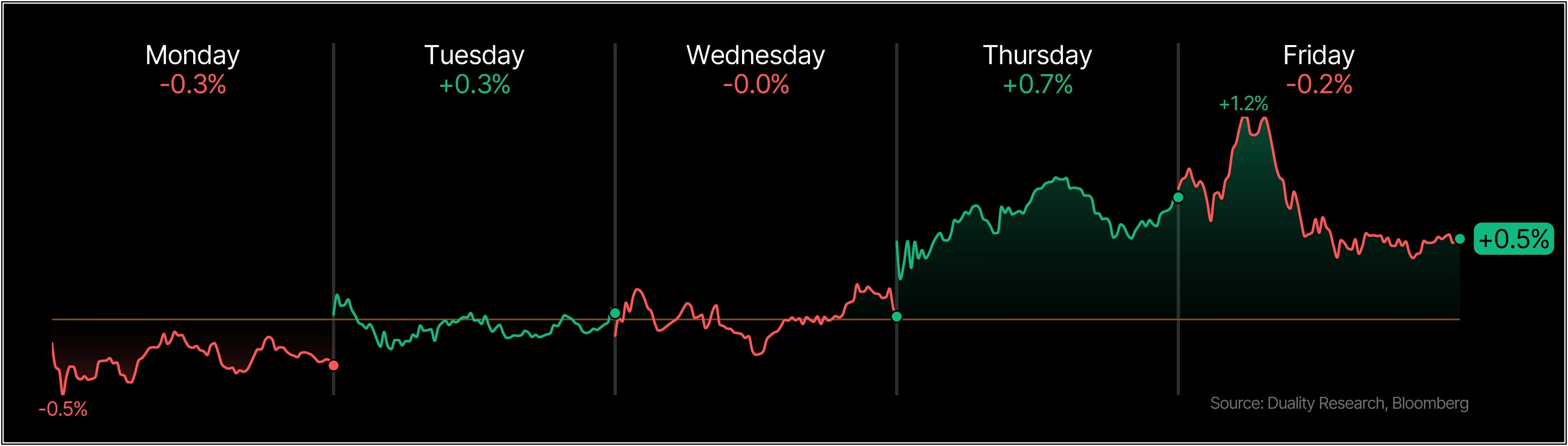
Monday — The Indexes Looked Worse Than the Market
The week began cautiously.
The S&P 500 fell 0.3% and the Nasdaq declined 0.8% as semiconductor stocks remained under pressure ahead of Nvidia’s earnings.
But underneath the indexes, the picture was actually much healthier.
Despite the S&P 500 decline, eight of its 11 sectors finished higher and the equal-weight S&P 500 gained 0.1%.
So Monday’s message was:
The indexes looked weaker than the market underneath them.
Semiconductor selling was heavy enough to drag down the cap-weighted averages, but buyers were still active elsewhere.
Keep that in mind.
Because by Thursday, the exact opposite was happening.
Tuesday — Chips Got a Bounce
Technology rebounded Tuesday as investors returned to semiconductor stocks.
The PHLX Semiconductor Index gained 1.4%, Nvidia snapped a seven-session losing streak, and the Nasdaq led the major indexes higher.
But this wasn’t broad buying.
It was mainly traders stepping back into chips ahead of Nvidia.
The market was loading up for the possibility that Nvidia would once again tell everyone the AI boom was alive.
It did.
Wednesday — Inflation Didn’t Change the Story. Nvidia Did.
Headline PCE remained 3.7% year over year, while core PCE remained 3.3%.
September hike odds briefly moved toward 40%, then fell back toward 36% by the close.
In other words:
The inflation report didn’t really change the market’s mind.
Then Nvidia reported.
Revenue reached approximately $96.2 billion, up 106% year over year, while earnings more than doubled.
But the number that really got my attention was farther out.
Nvidia projected approximately 70% revenue growth for fiscal 2028.
That is not what an AI spending bust looks like.
The AI infrastructure buildout is not slowing the way many investors feared.
If Nvidia is even close to right, enormous amounts of money are still going into chips, memory, networking, electricity, cooling, data centers and everything else required to build this infrastructure.
The AI boom isn’t disappearing.
The opportunity is spreading.
Thursday — AI Ripped. Most Stocks Didn’t.
Thursday looked fantastic if you only watched the indexes.
The Nasdaq gained 1.6%, the S&P 500 rose 0.7%, and Nvidia surged 8.7%.
Software was even better.
IGV jumped 7.7% in a single session as Salesforce gained 22.6% and CrowdStrike rose 20.5%.
Great day, right?
Not exactly.
Technology was the only one of the 11 S&P 500 sectors to finish higher.
The equal-weight S&P 500 actually fell 0.3% while the cap-weighted S&P gained 0.7%.
Now compare that with Monday.
Monday: S&P 500 down, eight sectors higher.
Thursday: S&P 500 up, only one sector higher.
That’s a pretty dramatic change in just a few days.
The week began with the indexes understating the strength underneath the surface. It ended with the indexes overstating it.
That doesn’t mean the market is breaking.
But it does mean we should stop pretending every green index close represents broad strength.
The Biggest Opportunity Development: AI Moves Downstream
This may have been the most interesting thing that happened all week.
Software came alive.
For months, investors have worried that AI would eat traditional software alive.
Maybe that story was too simple.
Salesforce’s results pointed toward improving demand.
CrowdStrike delivered another strong quarter.
Okta, Elastic and Workday also produced encouraging reactions.
And then there are the weekly numbers:
Software: +5.9%.
Semiconductors: -2.3%.
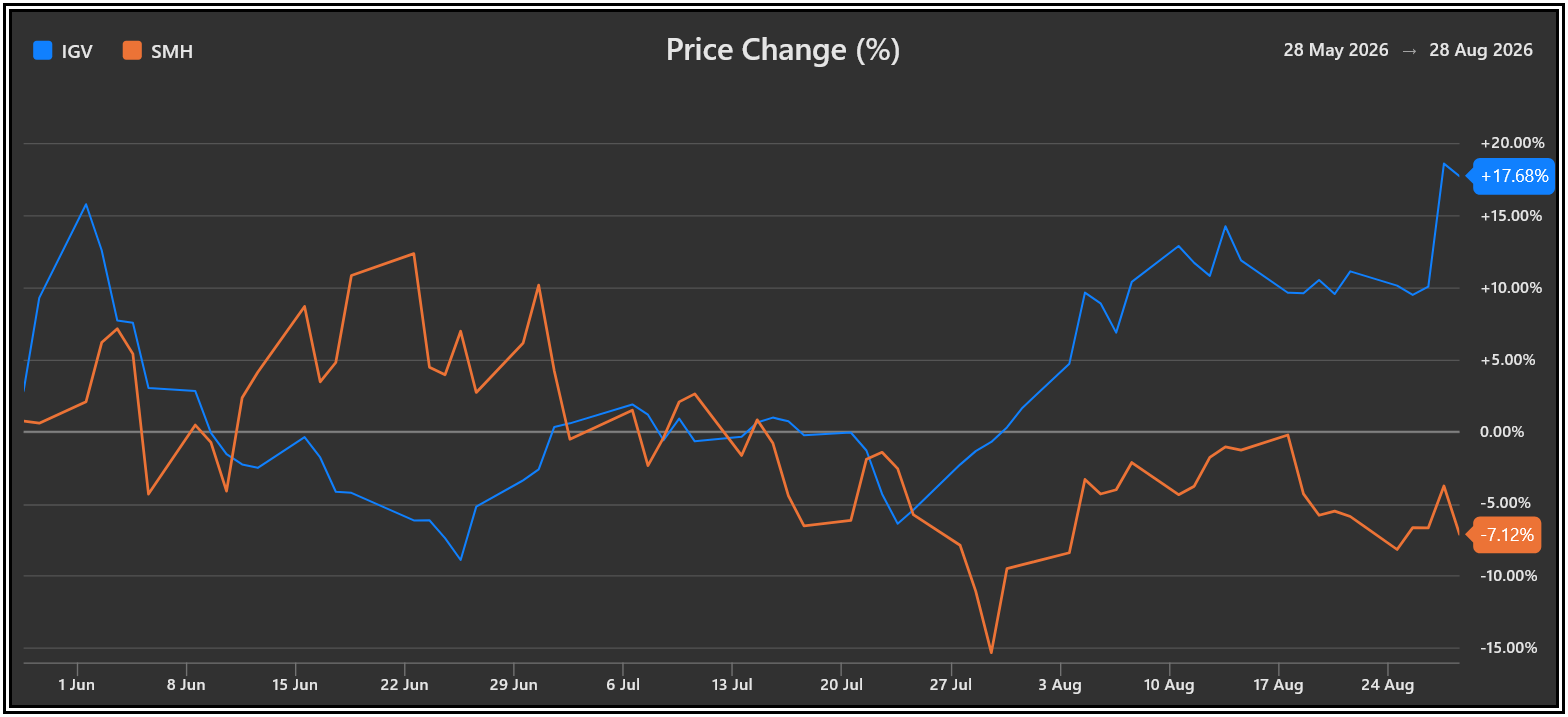
That’s not noise.
That’s rotation.
The AI opportunity map increasingly looks like this:
Semiconductors → Networking → Power → Infrastructure → Software → Cybersecurity → AI Adopters
And cybersecurity may deserve much more attention.
AI gives companies enormous new capabilities.
It also gives attackers enormous new capabilities. More models. More identities. More autonomous agents. More attack surfaces. More things that need protecting.
In this new era, here is the uncomfortable truth: the attack surface keeps expanding. That is one reason cybersecurity is becoming increasingly important.
This is why cybersecurity is prospering.
So AI may create two spending cycles at once:
Companies spend billions deploying AI.
Then they spend billions making sure nobody blows it up.
That’s interesting.
The next phase may increasingly reward the companies that: connect AI, power it, monetize it, secure it, embed it into workflows, and use it to improve productivity.
Don’t abandon AI.
Stop assuming all the money has to be made in the chipmakers.
Friday — Warsh Put Rates Back in Charge
Then Warsh showed up.

The Fed Chair used Jackson Hole to emphasize that inflation remains above the Fed’s 2% objective and that price stability remains the priority.
The market got the message immediately.
The implied probability of a September 25-basis-point hike jumped to 57.5% from 35.4% the previous day.
Wednesday’s inflation report didn’t change expectations much.
Warsh did.
And the reaction was concentrated where you would expect it.
The 2-year Treasury yield jumped 12 basis points Friday to 4.35% and finished the week 12 basis points higher.
The 10-year yield finished at 4.72%, actually 2 basis points lower for the week.
That tells me this was primarily a Fed-policy repricing, not some broad panic across the entire bond market.
Still, rates remain the biggest obstacle to making this equity market easier.
Until yields begin to ease, higher-duration assets are going to keep fighting gravity.
Friday’s damage showed up most clearly away from the mega-caps.
The Russell 2000 fell 1.4% and the S&P MidCap 400 declined 1.2%.
Nvidia fell 4.6%.
Marvell dropped 10.3%.
And that’s where the conversation changed.
It went from:
AI growth is accelerating.
to:
Great. How much are we willing to pay for it if rates stay high?
That’s a harder question.
And right now, it matters more.
The Week in Numbers
S&P 500: +0.5%
Nasdaq Composite: +0.9%
Dow Jones Industrial Average: +0.5%
S&P MidCap 400: -1.3%
Russell 2000: -1.5%
That’s the week in one snapshot.
Large caps up.
Small and midcaps down.
Software ripping.
Semiconductors struggling.
Not a bear market. Not a raging bull market either.
It’s chop.
