

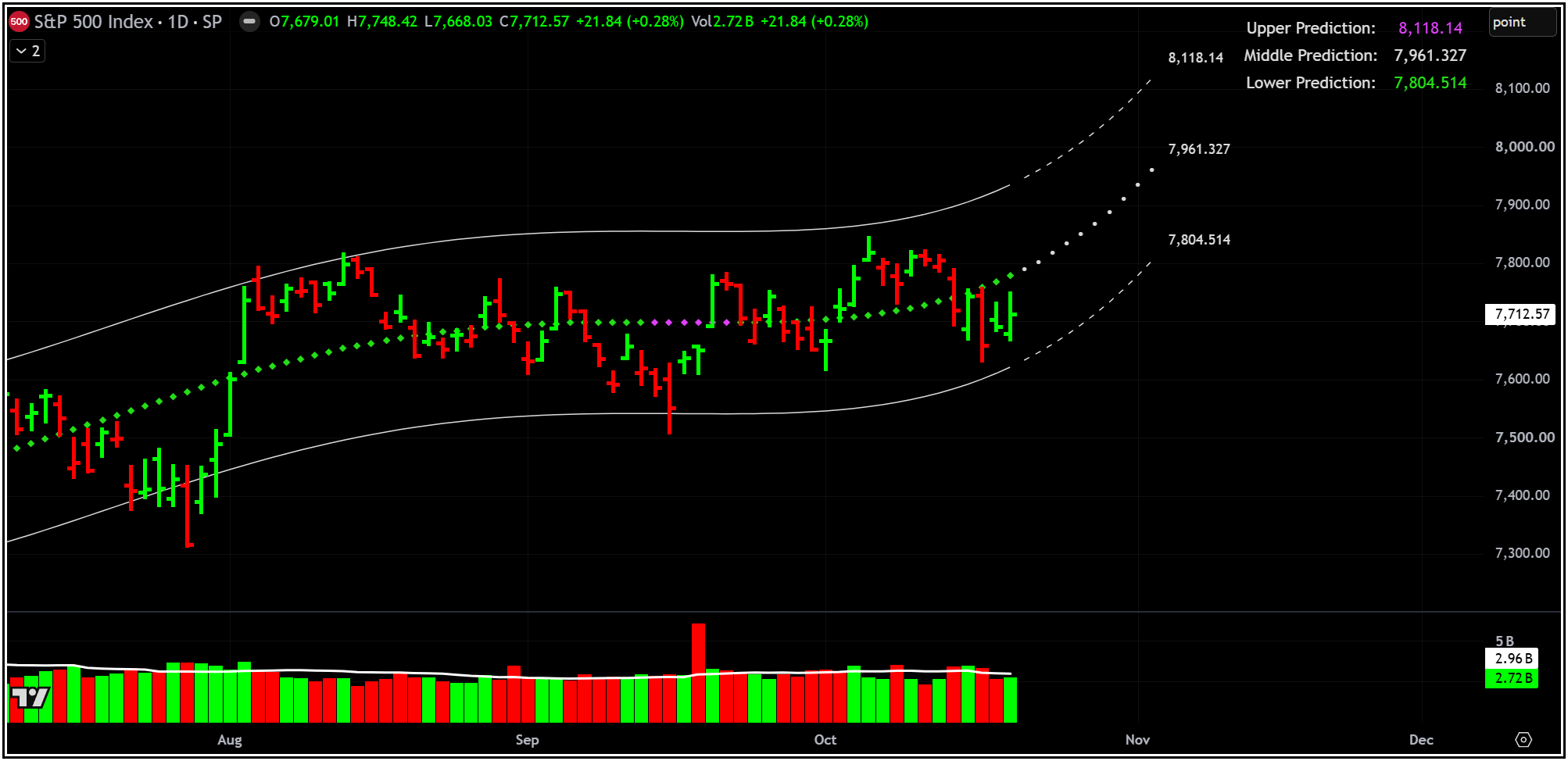
The big picture: The market has spent two sessions demonstrating that weakness in the AI trade does not necessarily mean weakness everywhere else. Meanwhile, the earnings season is exposing a growing divide between companies producing impressive growth and those capable of financing that growth profitably.
With price holding around 7700ish, the polynomial regression channel is finally turning upward again after one of its longest periods this year pointing lower.
As my friend Dave Landry would say, its “better than a poke in the eye.”
Nevertheless, the week is just getting started.
I would rank these five developments by their importance to the market’s next move, rather than by how much attention they received.
1) The Rotation Continues
Most constructive development
Monday’s advance was led by technology and semiconductors.
Tuesday’s advance was led by smaller companies, industrials, and other economically sensitive sectors.
That change is significant.
The Russell 2000 gained 1.65% Tuesday while the Nasdaq declined slightly. The Dow rose more than 1%, and the S&P 500 finished higher despite weakness in several technology stocks.

Why it matters: Broadening leadership would make the rally less dependent on a handful of highly valued AI stocks. That could improve the durability of the bull market even if technology takes time to consolidate.
The next confirmation would be several sessions of sustained small-cap, equal-weighted, and financial-sector outperformance.
2) SpaceX Attempts Another Blastoff
Most important earnings development
SpaceX reported third-quarter revenue of $14.6 billion, up 161% year over year, and net income of $4.4 billion. Its AI division generated about $7.6 billion in quarterly revenue.
However, total capital expenditure reached $19.6 billion, including $16.4 billion related to AI.
The implications extend far beyond SpaceX.
AI infrastructure demand is substantial and generating revenue now.
The capital required to meet that demand is enormous.
Investors increasingly need evidence of attractive returns on invested capital, not simply expanding revenue.
Why it matters: The AI investment boom can be fundamentally real while still producing financing problems, disappointing returns, and overvalued securities.
SPCX’s price action is constructive, especially if the very positive initial reaction to earnings tonight continues. The secondary cup/handle play targeting $194 has just seen what appears to be an apparent bear trap, retest move.
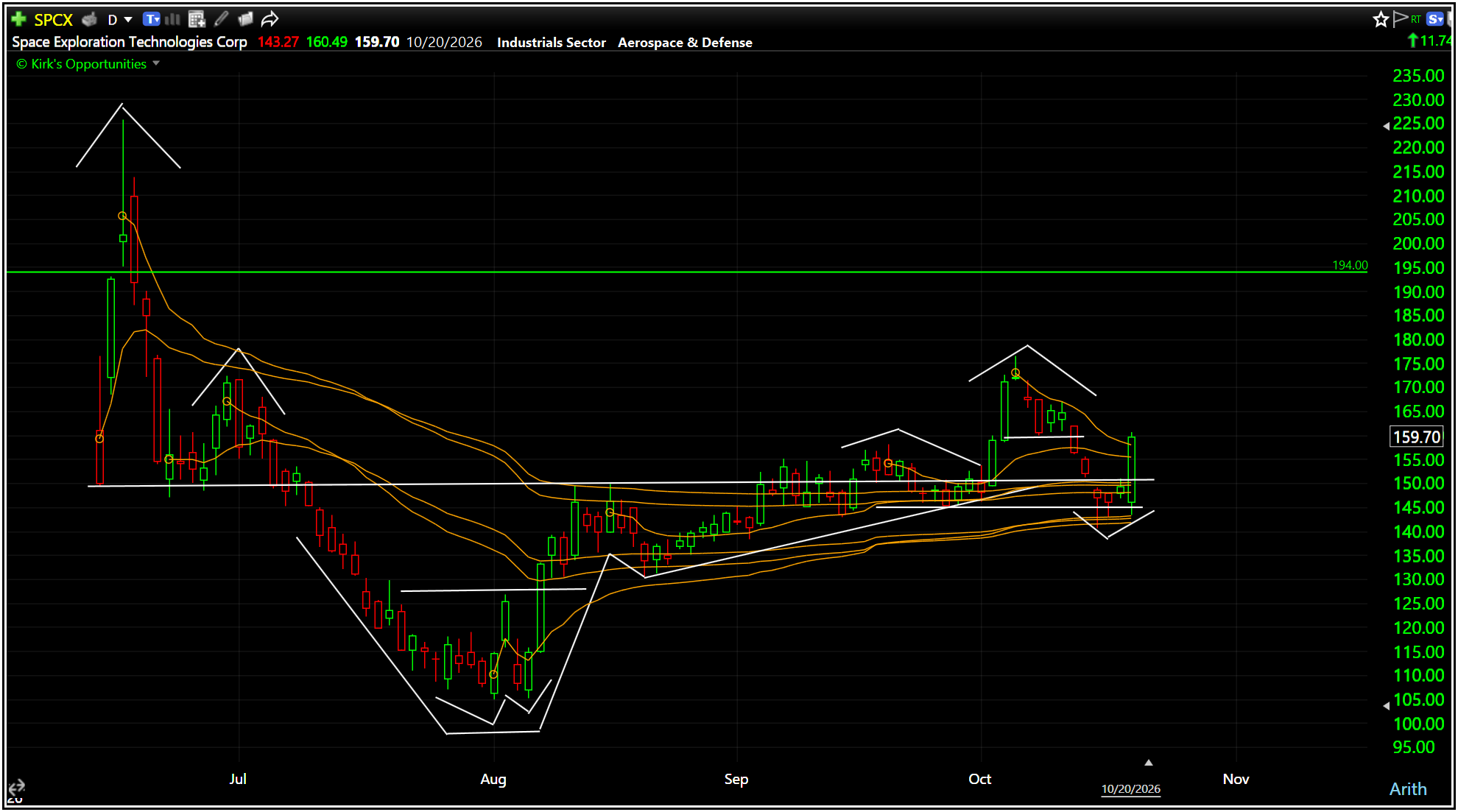
In addition to the price action (first, foremost and always), if SPCX is your investment, I would pay particular attention to capital spending relative to operating cash flow, credit spreads, and the performance of AI infrastructure bonds moving forward. These factors will put the price action into some context for you to consider when evaluating your risk/reward analysis.
3) Stubborn Yields
Bond yields remain elevated even after easing modestly Tuesday. The 10-year Treasury yield finished around 5.12%, and financing costs continue to weigh on housing, smaller companies, and capital-intensive businesses.
This reinforces one of our most important market relationships:
Higher yields → Higher financing costs → More demanding valuations → Pressure on equity leadership.
A sustained easing of long-term yields could help financials, housing, small caps, and other previously corrected sectors. Renewed yield increases could undermine the developing rotation.
The critical distinction is whether yields are easing because inflation pressures are improving or because growth prospects are deteriorating. Which is tough to figure out even for the experts!
4) Selective About Earnings
One of the most important changes in market behavior is the increasing differentiation between companies benefiting from AI and those struggling to translate investment into sustainable returns.
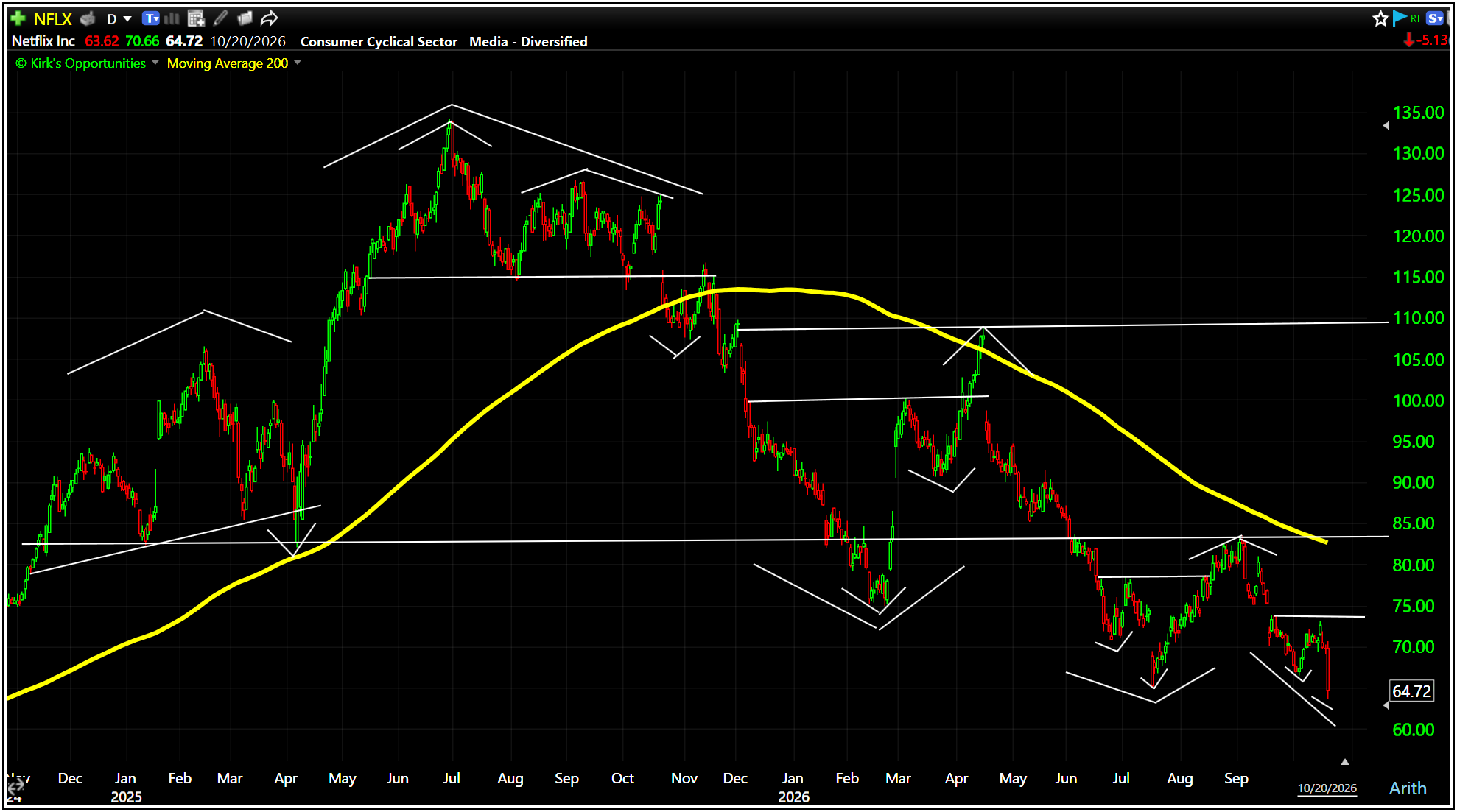
SpaceX’s results initially encouraged investors. Netflix, however, faced a less forgiving response after its outlook disappointed expectations. At the same time, some semiconductor and AI infrastructure stocks remained under pressure despite Monday’s rebound.
Of course, with the weak and consistently challenging price action in the last 18 months, particularly under the 200DMA, it is difficult to buy these multi-year lows without showing more consistent, positive price action first.
As my notes will show these past two years, it is difficult to trade a stock like this which has been particularly trap-prone for bulls and bears alike. This stock also reminds us that trying to buy the dip in a stock that trades below its 200DMA tends to not work out too well.
The next tests come from Meta and Tesla on Wednesday, October 21. Investors will be watching whether earnings, guidance, margins, and spending plans justify existing valuations.
Based on the performance split between the two, there is more confidence in Tesla than Meta, so it will be interesting to see if that has anything to do with the reactions.

Why it matters: This will continue to confirm the transition from buying virtually anything associated with AI to only rewarding companies that demonstrate improving profitability and capital efficiency.
For stock selection, that would be a potentially important change. Strong themes would remain investable, but company-specific execution and price confirmation would become more important.
5) Credit Vulnerabilities
The most concerning development beneath the equity market involves financing for the AI infrastructure buildout.
Research I examined today highlighted bonds financing CoreWeave-leased data centers trading well below par, while other research raised concerns about growing credit-hedging activity.
These are warnings of possible financing pressure, not proof of a systemic credit event.
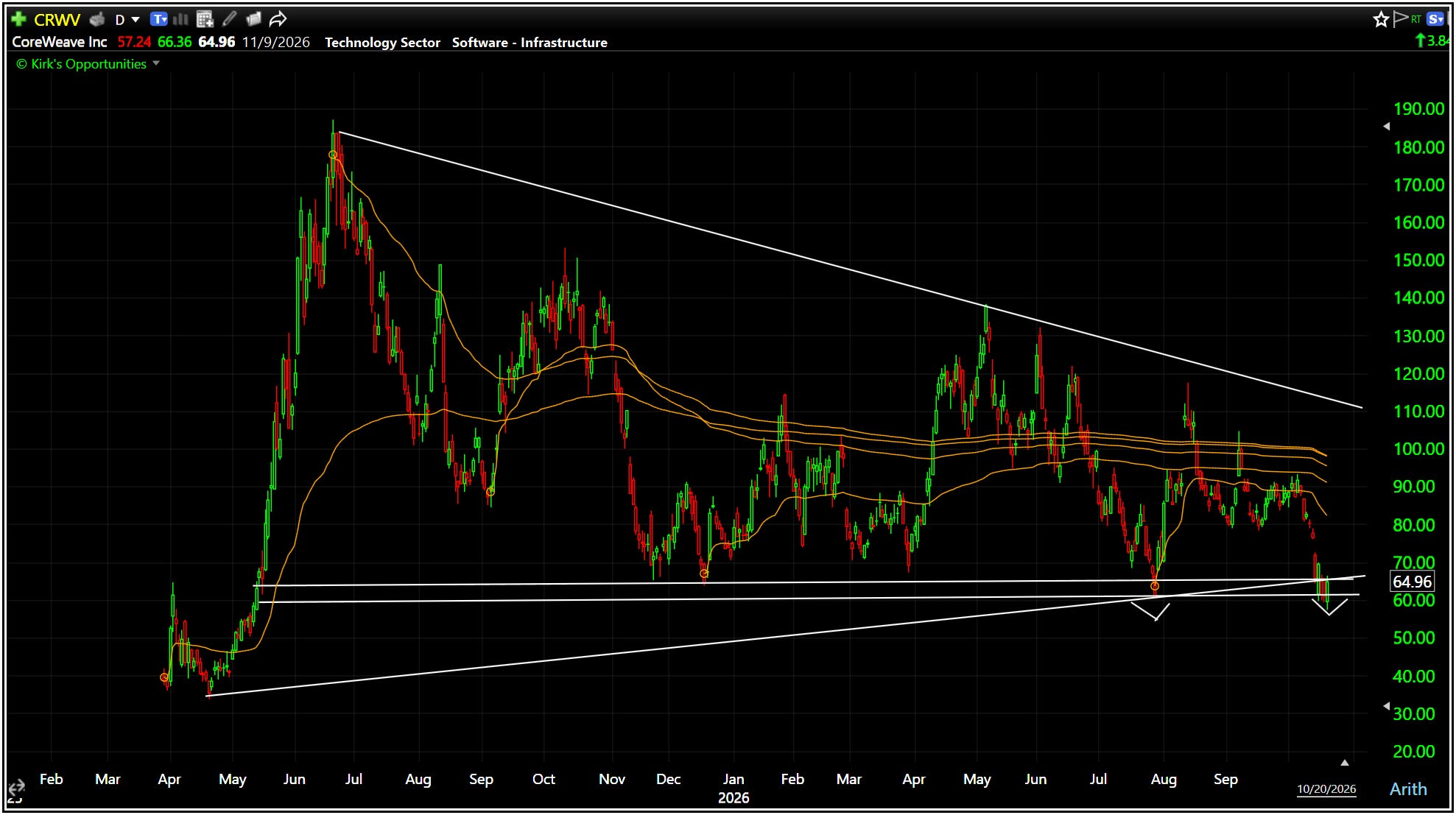
Why it matters: AI infrastructure increasingly depends on access to large amounts of capital. Rising financing costs could eventually affect construction schedules, customer economics, valuations, and equity issuance.
Risk Check
Three buckets to keep in mind:
Bullish: Rotation is broadening. Small caps and economically sensitive groups are attracting buyers, potentially reducing dependence on mega-cap technology.
Caution: Treasury yields remain elevated, AI-related credit financing is becoming more complicated, and semiconductor leadership has not fully recovered.
Unresolved: Whether recent rotation develops into sustainable broader leadership, and whether the earnings season confirms enough growth to justify valuations.
Three Priorities For Wednesday
1) Watch financials and small caps for follow-through. Continued strength would reinforce the idea that the market is broadening rather than breaking down. XLF/SPY, regional banks, IWM, and RSP/SPY are the most useful comparisons.
2) Watch semiconductor leadership. AMD, NVDA, MU, and LITE need to demonstrate that buyers can defend support and rebuild relative strength. A broadening market with recovering technology leadership would be especially encouraging.
3) Watch the reaction to earnings, not just the earnings themselves. Meta and Tesla will help reveal what investors are prepared to pay for growth and whether the market’s appetite for large capital expenditures is changing.
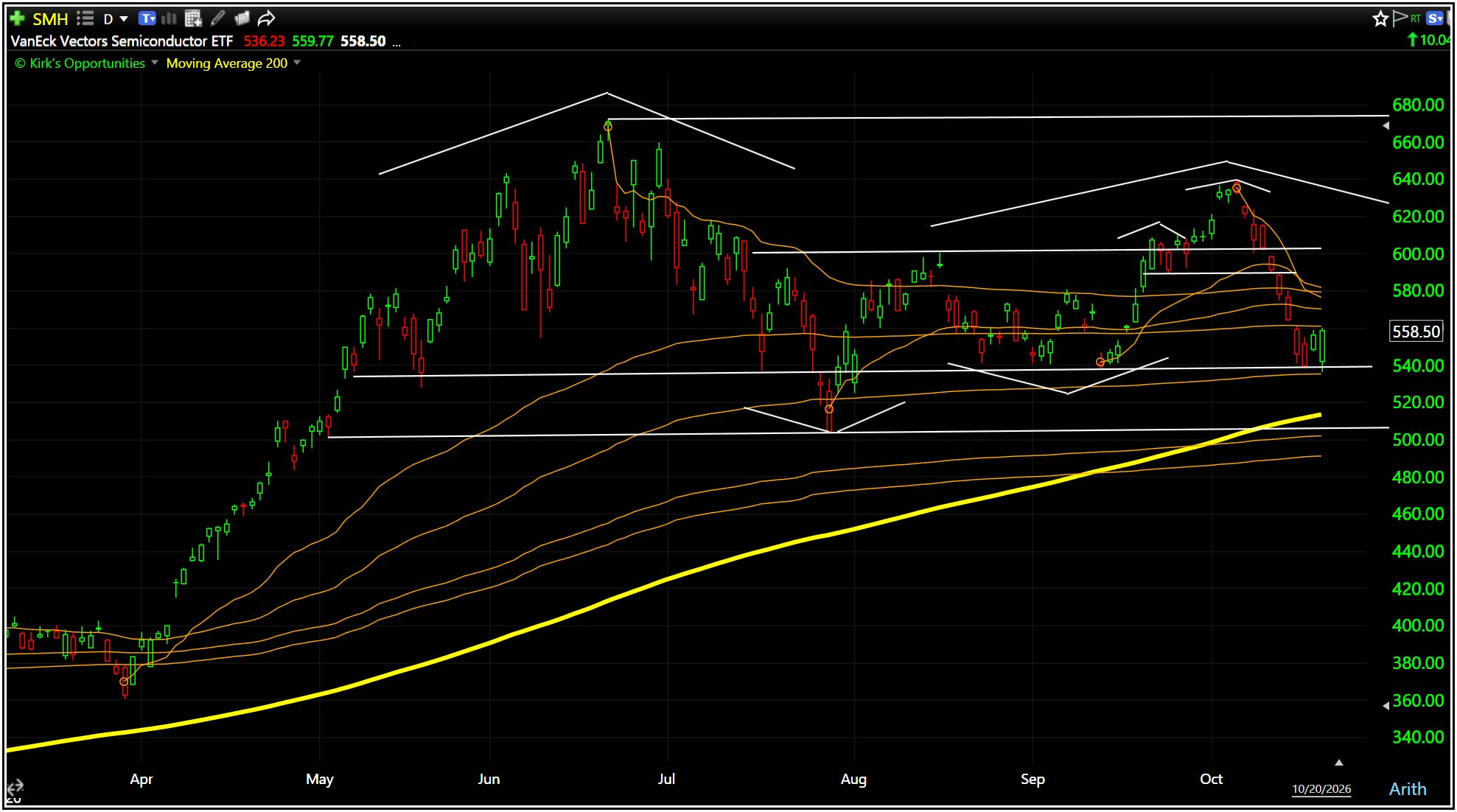
FYI - this is what I see when in the beaten up, chip trade - more sideways range consolidation and chop with bulls and bears fighting for control as its 200DMA rises up to meet it within the range. None of this is particularly surprising given the immense amount of buying by retail investors into the June high only to become more “situationally aware” that things got a overcooked by Leo and the momentum-seeking individual investors chasing stocks in the 9-week, second quarter rally.
The Bottom Line
The most important development of these first two sessions is that the market is beginning to behave as though opportunities exist beyond the AI leaders.
In fact, some of the best performing stocks of late have been those stocks which were hit by AI-driven fears, like we see in the software stocks, as investors look for lower-valuation, lower-risk opportunities there.
The interesting possibility is that the AI trade undergoes a necessary correction while capital rotates toward other opportunities, allowing the broader bull market to continue.
At least until people stop worrying about the mid-term election.
Radar
The midterms are being used as a clearing event for risk, the election odds favor a big blue wave, data center moratoriums are just one of the many issues on the ballot, political anxiety is always our #1 opportunity, Uncle Sam’s financial plans are sparking anxiety again, in times of stress watch the free cash flow, changes to Oppenheimer’s top 50 is making the rounds, four conditions for a sustainable AI recovery, and the plethora of tasks AI agents can do to help you.
“How to see opportunities others miss: 1) Study a totally different field, then return to the original problem. Apply insights from other domains. 2) Invert the problem. Try to achieve the opposite. 3) Find ways to engage with hyper-creative people. Their thinking will rub off.” - James Clear