


Some market environments reward aggression.
Others reward patience.
In a strong trending market, breakouts follow through, leaders keep leading, pullbacks get bought, and good stocks have room to run.
In a choppy market, that rhythm disappears. Leadership rotates, rallies stall, strong stocks give back gains, and attractive setups repeatedly fail to make progress.
The mistake is assuming we should keep doing the same things with the same levels of aggression.
We don’t not need a different approach every time conditions become difficult.
Instead, we need a different level of exposure and a higher standard for committing new capital.
In other words, keep the process. However, at the same time, adjust the aggressive positioning and our approach.
What Does a Choppy Market Look Like?
A choppy market usually lacks a persistent directional trend. The indexes may move sideways, leadership changes frequently, and stocks struggle to sustain advances.
One failed breakout means little. A pattern of failed breakouts means more. One disappointing earnings reaction is noise. Strong companies repeatedly selling off after good results is information.
The goal is not to perfectly label the market. It is to recognize when risk is no longer being rewarded as consistently as before.
Let Your Portfolio Tell You Something
You do not need to trade frequently to learn from your own results. For many investors, the portfolio they already own provides some of the best evidence about the environment.
Once a week, score these seven questions:
2 = positive, 1 = mixed, 0 = negative
Are my strongest holdings making progress?
Are recent purchases gaining traction?
Are my best stocks outperforming the S&P 500?
Are gains generally being retained?
Are most holdings maintaining important support?
Are good earnings reports being rewarded?
Is my overall portfolio making progress?
Add the scores:
12–14: Strong
9–11: Constructive
6–8: Mixed/choppy
3–5: Difficult
0–2: Poor
If a question does not apply, leave it out rather than assigning a zero.
More important than any single score is the direction.
12 → 10 → 8 → 6 signals deterioration.
5 → 6 → 8 → 10 suggests improvement.
The score is not meant to predict the market. It answers a more useful question:
Is the market currently rewarding the way I invest?
Track the Portfolio, Not Every Wiggle
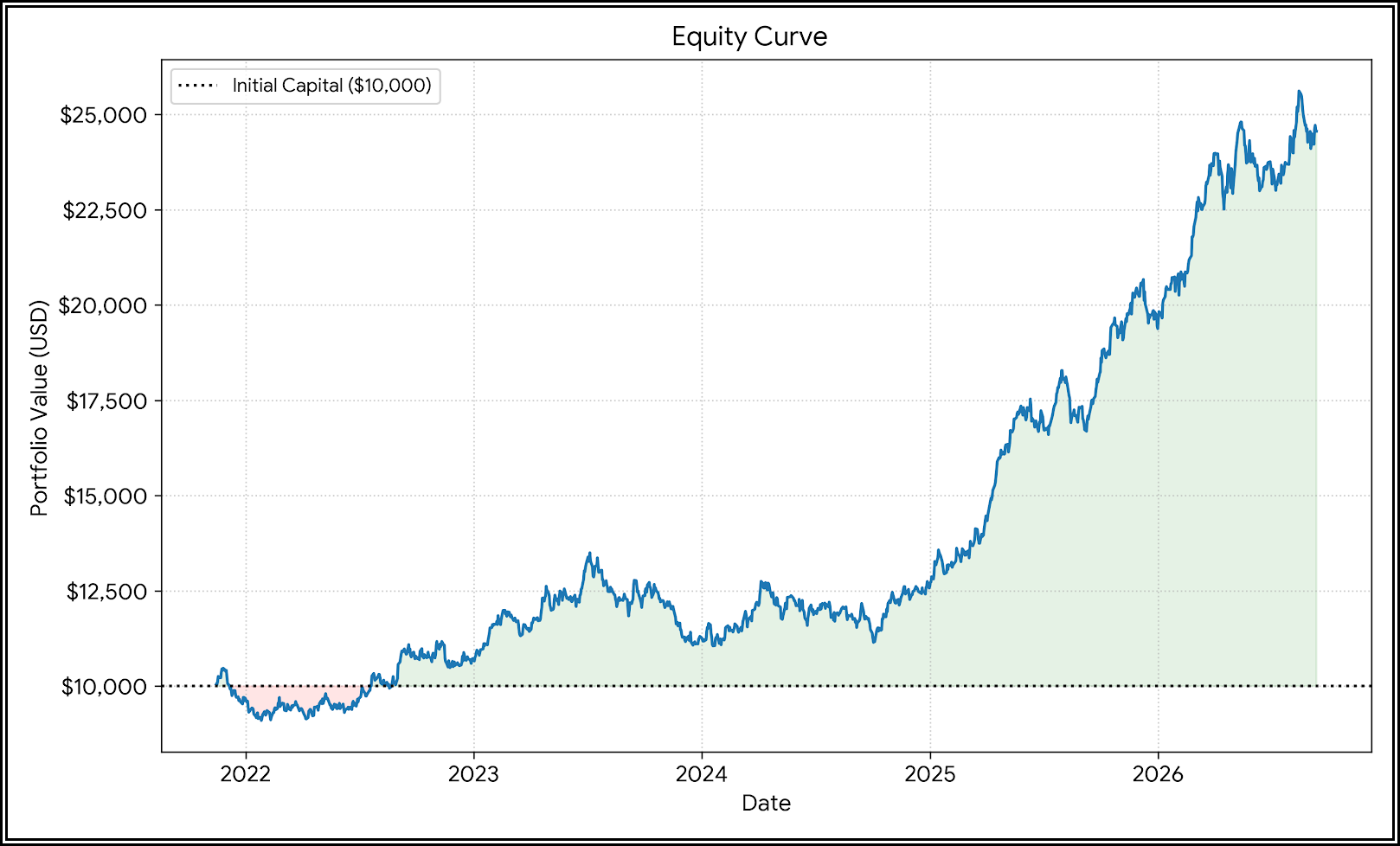
A simple equity curve adds another layer of feedback.
Record your portfolio value once a week or once a month and plot it on a line chart. You are not reacting to every decline. You are looking for a change in character.
A steadily rising curve suggests your strategy and the market remain reasonably aligned. A flattening or declining curve—especially alongside a falling Portfolio Feedback Score—may be telling you to become more selective.
Comparing the portfolio with the S&P 500 can also help. If the market struggles while your portfolio holds up well, your holdings may possess strong relative strength. If the S&P 500 advances while your portfolio consistently deteriorates, the problem may be more specific to what you own.
The equity curve is not a prediction.
It is feedback.
Keep Doing the Work
A difficult market is not a reason to stop working.
Continue screening for relative strength. Continue studying earnings. Continue maintaining a buy list. Continue following your strongest companies and looking for improving industries and emerging leadership.
Periods of weakness can also improve future risk/reward. Prices come down, excessive optimism gets removed, and strong companies can begin separating themselves from weaker ones.
The key is not simply buying because something has fallen. It is watching for the point when weakness begins turning into improvement.
That might mean a stock stops making new lows, relative strength begins improving, support starts holding, earnings reactions strengthen, or your Portfolio Feedback Score begins rising.
That combination can be especially attractive: better prices after weakness, accompanied by improving evidence.
Choppy markets eventually end, and some of the next leaders may begin revealing themselves before the major indexes clearly improve.
Preparation stays high.
Exposure can come down and rise again as the evidence improves.
Raise the Hurdle for New Purchases
Choppy markets are usually a poor time to lower your standards simply because you want to do something.
Instead of asking:
Is this stock good enough to buy?
Ask:
Is this opportunity better than simply waiting?
A strong opportunity may combine improving fundamentals, strong relative strength, a favorable industry trend, attractive price action, and a clearly defined risk point.
In easy markets, mediocre setups sometimes work anyway.
In difficult markets, selectivity becomes an edge.
Start Smaller When the Evidence Is Mixed
One of the easiest ways to reduce risk without abandoning an attractive idea is to begin with a smaller position.
Suppose your eventual goal is a 6% portfolio position. You might begin with 2% or 3%.
Then observe.
Does the company continue executing? Does the stock hold support? Does relative strength improve? Does the broader environment become more favorable?
If the evidence improves, add.
If it deteriorates, the initial mistake was inexpensive.
The market should earn additional capital.
Progressive Exposure
Progressive exposure means increasing capital as conditions improve rather than trying to predict the exact moment the market turns.
At the position level:
Buy one-third → observe → confirm → add
At the portfolio level, exposure can rise gradually as conditions improve—or fall as evidence deteriorates.
The exact percentages matter less than the principle:
Exposure should respond to evidence, not conviction.
You do not have to decide in advance whether the market is bullish or bearish. Let your holdings, new opportunities, leadership, and price action answer that question over time.
Do Not Confuse Smaller Risk With Arbitrarily Tight Stops
A common response to volatile markets is to move stops closer to the entry price.
Sometimes that makes sense. Sometimes it simply creates more whipsaws.
If normal volatility increases, an artificially tight stop may cause you to sell a reasonable position simply because the stock moved around more than usual.
A better approach is often to keep the stop at a significant level and reduce the position size instead.
Suppose you buy a stock at $100 and believe the setup is invalid below $95.
A $10000 position with a 5% stop represents $500 of risk.
A $5000 position with the same stop represents $250.
The risk has been cut in half without moving the stop somewhere the chart does not support.
The stop answers:
Where am I wrong?
Position size answers:
How much am I willing to lose if I am wrong?
Those are related decisions, but they are not the same.
Adjust Your Expectations
Strong trends encourage investors to let winners run.
Choppy markets often produce shorter advances and faster reversals.
That does not mean every investor should become a short-term trader. It means expectations should reflect what the market is actually delivering.
If stocks repeatedly rise, stall, and surrender gains, it may make sense to trim an extended position, avoid chasing strength, or wait for a better entry.
The lesson is not:
Take profits at 5%.
It is:
Do not demand a 30% move from a market that keeps offering 8%.
Zoom Out Before You React
Daily charts can make choppy markets look more dramatic than they really are.
Weekly charts often restore perspective.
A stock that looks chaotic from one day to the next may simply be building a large base. Major support, resistance, and the broader trend often become clearer when the time frame is expanded.
This is especially useful for longer-term investors.
One of their advantages is that they do not have to participate in every short-term argument the market is having with itself.
Watch the Leaders
Strong stocks often provide early clues about changing conditions.
During a difficult market, pay attention to companies that hold important support, decline less than the broader market, recover quickly after weakness, maintain strong relative strength, and respond well to positive fundamental developments.
These companies may become future leaders when conditions improve.
The opposite matters too. If former leaders begin breaking support, losing relative strength, and selling off on good news, the market may be sending a warning before the major indexes visibly deteriorate.
Pay Attention to Earnings Reactions
The reaction to news is often more informative than the news itself.
A company can report excellent earnings and raise guidance, yet see its stock sell off. The fundamentals may still be excellent, but investors are telling you they are unwilling to pay more for them at the current price.
The opposite can happen as conditions improve. Merely decent results begin producing strong rallies.
Do not just ask:
Was the news good?
Also ask:
How did investors reaction to the news? And not just the day afterwards, but in the weeks that follow!
Avoid the Activity Trap
Choppy markets often tempt investors to become more active precisely when activity has a lower expected payoff.
One stock stalls, so they sell it and buy another. That position stalls, so they rotate again. Soon they are making more decisions while producing worse results.
The better answer may be higher selectivity and fewer decisions.
Sometimes the correct move is to hold your best positions, sell what has genuinely deteriorated, and wait.
Cash is not a failure of imagination. It is capital waiting for better odds.
A Simple Choppy-Market Checklist
Before increasing exposure, ask:
Are my strongest holdings still acting well?
Are genuinely attractive new opportunities appearing?
Is my Portfolio Feedback Score improving or deteriorating?
Is my equity curve making progress?
Are market leaders holding their gains?
Are good earnings reports being rewarded?
Am I adding because the evidence improved—or because I am bored?
That last question deserves more attention than it gets.
The Bottom Line
Choppy markets are tests of patience, selectivity, and adaptability.
The objective is not to squeeze maximum returns from every environment. Sometimes the best decision is simply preventing a difficult period from creating unnecessary damage.
But difficult markets can also create the foundation for future opportunity. Lower prices, washed-out expectations, and improving price action can produce far better risk/reward than existed when everything looked easy.
For an active investor, adapting may mean fewer trades and smaller positions.
For a longer-term investor, it may mean slower capital deployment, fewer portfolio changes, and a higher hurdle before committing additional money.
Both approaches follow the same principle:
Do not force the market to provide opportunities it is not currently offering.
Eventually, leadership will strengthen, trends will persist, strong companies will be rewarded, and taking more risk will make sense again.
The investor who stayed prepared, protected capital, and watched carefully for improving evidence will be ready.
You do not need to make money in every market environment.
You need to preserve capital and confidence while remaining prepared for the moment the odds begin turning back in your favor.
Let the market earn the right to receive more of your capital.
- C.E. Kirk
Every day I assume every position I have is wrong. - Paul Tudor Jones