


The Bottom Line
The S&P 500 did what we were looking for it to do.
It pushed into the 7,400 target zone, closed near another all-time high, and extended its winning streak to six straight weeks.
That is not just a strong rally.
It is a historic, rare bullish winning streak in both size and speed.
Six weeks ago, the challenge was believing what the price action was starting to show. Many investors were short, sidelined, hedged, or still anchored to the prior weakness.
As usual, the price action changed first.
Then came the follow-through.
The investors who stayed aligned with the price action, played the bear-trap reversal, and added exposure along the way were rewarded quickly. The investors who did not are now trying to catch up, often by taking on more aggressive positioning.
Now the challenge is different.
The believers have profits to protect. That means raising stops where appropriate, respecting support, and watching for deterioration in price action, leadership, and trend structure.
The non-believers have underperformance to repair. That means owning the mistake, forgiving themselves, and building a path to get realigned without chasing emotionally after a historic move.
It also means not fighting the trend without price-action support.
Recently, even the chasers have been rewarded.
Maybe too well.
That is where the next risk begins to form.
A rally that began with many investors offsides can eventually pull those same investors too far in the other direction. Too bullish. Too leveraged. Too concentrated. Too willing to take risk after the market has already delivered a major move.
The largest short-term losses can often follow the largest short-term gains, not because strength is bearish, but because discipline often weakens after success.
The market has earned the right to consolidate. Historical studies following winning streaks like this suggest short-term gains often slow, pause, or give way to rotation.
That does not mean the rally is broken.
It means the market may need time to digest the advance.
Winning streaks do not automatically create major tops. Large upside moves usually become dangerous only when the foundations supporting them begin to break.
That is what matters now:
Price action. Trend. Support levels. Leadership behavior. Earnings. AI leadership. Reactions to good news.
If those foundations remain intact, consolidation should be treated as normal market activity, not the beginning of a major top.
What Happened Last Week
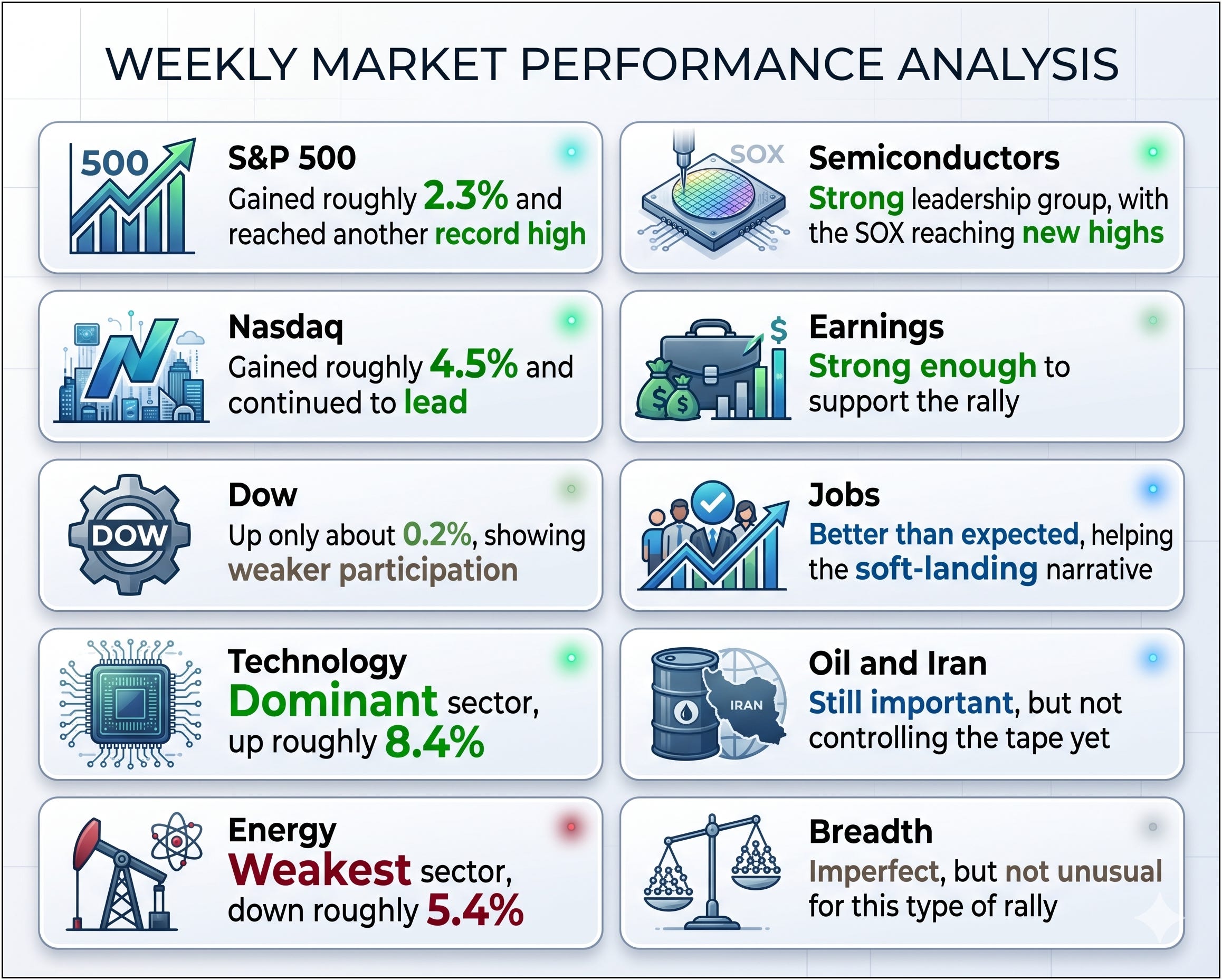
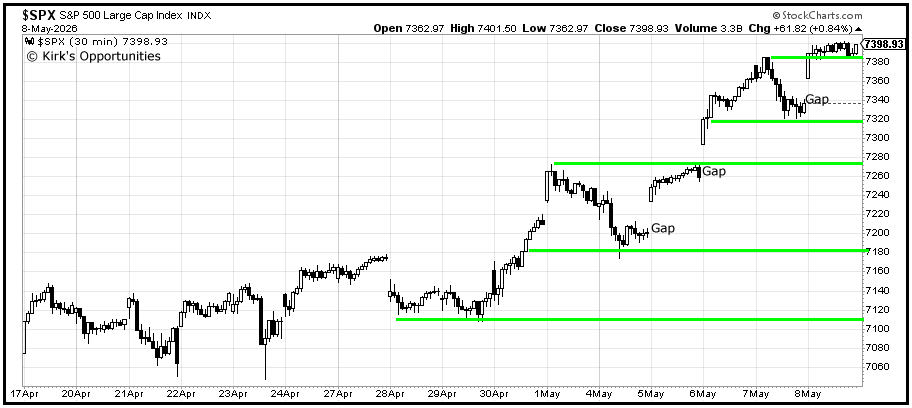
The S&P 500 and Nasdaq were helped by three large gap-higher opens on Tuesday, Wednesday, and Friday. That matters because it shows how aggressively investors were repositioning after stronger earnings, better economic data, and improving confidence in the outlook.
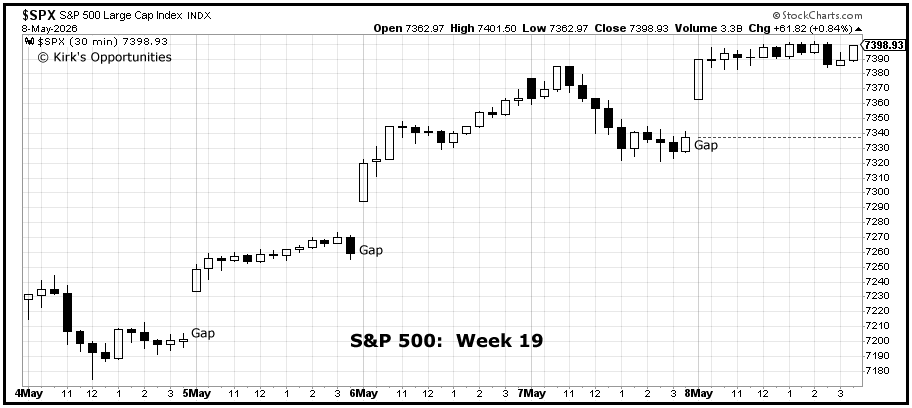
The simple read is this: the uptrend remains intact.
But there’s much more to it than that.
It is a full-court press to reposition after stronger earnings, better economic data, and a better-than-feared outlook.
That matters.
Not because the market is risk-free.
It never is.
But because the price action, the patterns, and the overall trend remain constructive, and the conviction behind this strength has been renewed.
The 7,400 Target Zone Has Arrived
The S&P 500 has now reached the 7,400 target zone.
It briefly touched that area Friday afternoon before ending the week near 7,398.
This target area has been on our radar since June 2025, when the long-term range breakout first put the 7,459 target into play. The following is the chart I shared previously:
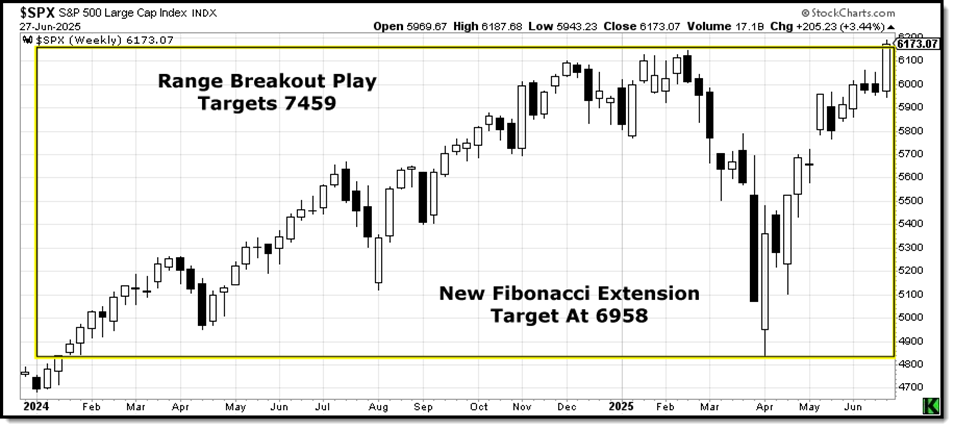
Now, we are there.
After the first-quarter volatility, the S&P 500 is in trend-extension mode.
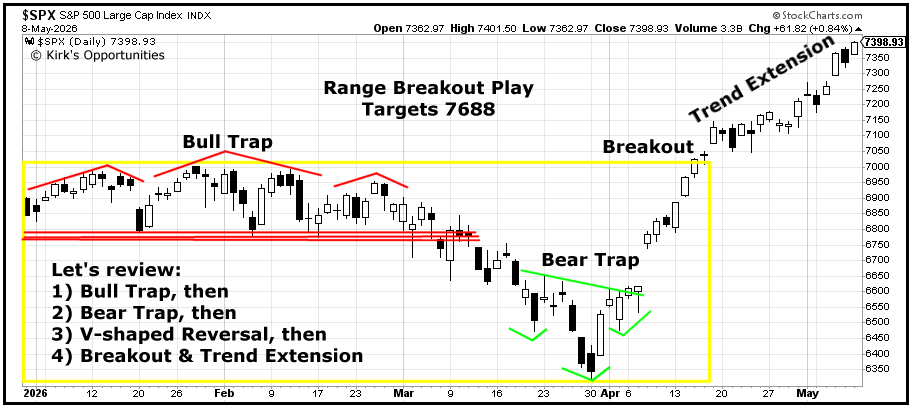
The current bullish price-action foundation has put three targets in play: 7,425, 7,459, and 7,688, which are +0.37%, +0.83%, and +3.93% from the last week’s close.
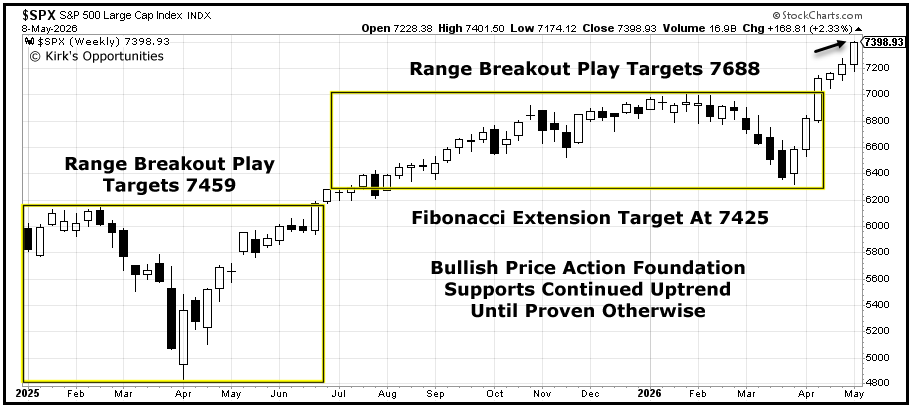
All three targets are within reach given the strong and sustained upside follow-through over the past three weeks. I currently assign a high probability that all three targets are eventually captured.
The only real question is when the market gets there and what path it takes.
As for support, the recent highs, lows, and three lower gaps from this month are all areas of interest. A throwback retest of the 7,002 to 7,202 area would likely be defended if tested.
The 21-day EMA is currently near 7,133 and should climb closer to 7,200 by Friday.
Potential Paths
A controlled pause around the 7,400 level would allow the market to digest gains, reset sentiment, rotate leadership, and create better entries.
That would be healthier than another vertical move that pulls too many investors into risk at the wrong time.
The point is not that upside is bad.
The point is that the quality of the upside matters.
A steady advance with rotation is healthier than a vertical move driven by urgency, FOMO, and leverage.
Without some consolidation and rotation along the way, the risk of a blow-off style advance increases. That would not necessarily be a problem immediately, but it could lead to a longer and more frustrating consolidation later.
That is not the base case yet.
It is simply a scenario worth respecting.
Under more normal market conditions, probabilities would mostly favor consolidation near the three targets in the 7,400 target zone.
But these are not normal market conditions.
They are extreme.
With so few comparable historical examples, the message is to remain open to multiple outcomes.
Put simply, this market has gone a little gonzo.
By that, I mean wild, extreme, and willing to stretch normal expectations.
Unless something new and unexpected alters the setup, price could move through these targets and get even more extended.
What Generates Sell Signals?
Price-action deterioration generates sell signals.
You know the drill by now.
Sell signals come from bull-trap reversals, failed support tests, lower highs, lower lows, and sustained downside follow-through.
We have none of those currently.
Yes, the market is extremely overbought.
Yes, it looks overcooked, especially in leadership areas like semiconductors and memory stocks.
But strength alone is not a reason to sell or short.
Strength is a reason to stay aligned with the trend until price action changes.
As I often say, “Make hay while the sun is shining.”
The sun is not only out. It is running at full strength right now.
This is a time to stay right if positioned right.
If you want to short, be patient until price action shows real deterioration.
If you are not positioned well, the job is not to chase emotionally. It is to look for opportunities to correct that mistake when price action offers a better entry.
Our Job Now Changes
Now that we have entered the S&P 500 7,400 target zone, the job changes.
We are no longer asking whether the market can get there.
It already did.
Now we are asking what the market does after arriving.
The questions are straightforward:
Do we see consolidation now or later?
Do any of last week’s three large unfilled gaps get targeted?
Does strength broaden beyond the AI-driven leadership groups?
My current view:
Consolidation is likely from the S&P 500 7,400 target zone.
Last week’s lower unfilled gaps are logical targets if selling begins.
A broadening rotation would be healthy and would help reduce blow-off risk.
That said, the mistake would be treating 7,400 like a hard ceiling.
The other mistake would be ignoring how far and fast price has already traveled.
The better approach is to let the market show us what this area becomes.
If the market does not pause, the 7,688 target remains in the crosshairs.
That is not prediction.
That is process.
For subscribers, the next question is how to manage this target zone, what would actually trigger sell signals, and which bull, base, and bear paths matter most from here.