

After four consecutive losing weeks, we were due for an oversold bounce. We got one, with the S&P 500 gaining 2.5%, but the recovery ran into resistance and lacked the strong, sustained follow-through needed to signal an end to the correction.
There were positives worth recognizing, including better participation within the S&P 500 and strength outside technology. But rising Treasury yields, stubborn inflation, and Nvidia’s unexpected leadership upheaval complicated the recovery. Buyers showed up without establishing convincing control.
That leaves us watching whether this bounce can develop into something more durable. Nvidia’s earnings, Anthropic’s expected debut, and a busy week of consumer data and retailer results should provide the next tests. We want to see stocks absorb the news, clear resistance, and hold their gains before committing more capital.
1) Broader Strength, But More To Prove

What improved: The bull trap reversals triggered by the November 5 liquidation did not produce further downside follow-through, giving an oversold market room to recover. Sellers had an opportunity to press their advantage, but didn’t do so. All four major indexes finished higher for the week.
More encouragingly, the S&P 500 Equal Weight ETF (RSP) moved back near its highs, showing strength beyond the mega-cap technology leaders. Healthcare, consumer staples, and other areas attracted buyers, while corporate earnings remained broadly strong. There is more life in this market than watching Nvidia and a handful of other giants might suggest.
What became more difficult: Strength continued to get sold in technology, with the sector, the Nasdaq 100, and the Nasdaq Composite ending a second consecutive week below their respective 200-day moving averages. Rallies brought buyers back, but sellers kept using that strength to unload shares. With this key leadership area still under attack, the market-cap-weighted indexes face a substantial obstacle to strong, sustained upside follow-through. Broader participation is encouraging, but the market’s biggest passengers are still making the climb harder.
Stubborn inflation and rising Treasury yields added to that difficulty, putting more pressure on expensive growth stocks and companies borrowing heavily to finance expansion. Nvidia’s unexpected leadership upheaval introduced another source of uncertainty for an already unsettled AI trade. Together, these pressures made it harder for buyers to turn an oversold rebound into a recovery we could trust.
What remains unresolved: We got the oversold bounce, but not enough strong, sustained follow-through to consider the correction over. RSP’s strength offers hope that new leadership can develop while technology repairs its damage. The next step is for that broader strength to produce new, actionable bullish plays and help the S&P 500 break its series of lower highs. We need stocks emerging from sound setups, holding their gains, and offering entries with manageable risk.
Next week’s Nvidia results, expected Anthropic debut, and consumer spending updates will test whether buyers are willing to build on the recovery. The announcements will matter. Whether stocks can hold their gains afterward will matter more.
2) Nvidia’s Leadership Is Under Attack
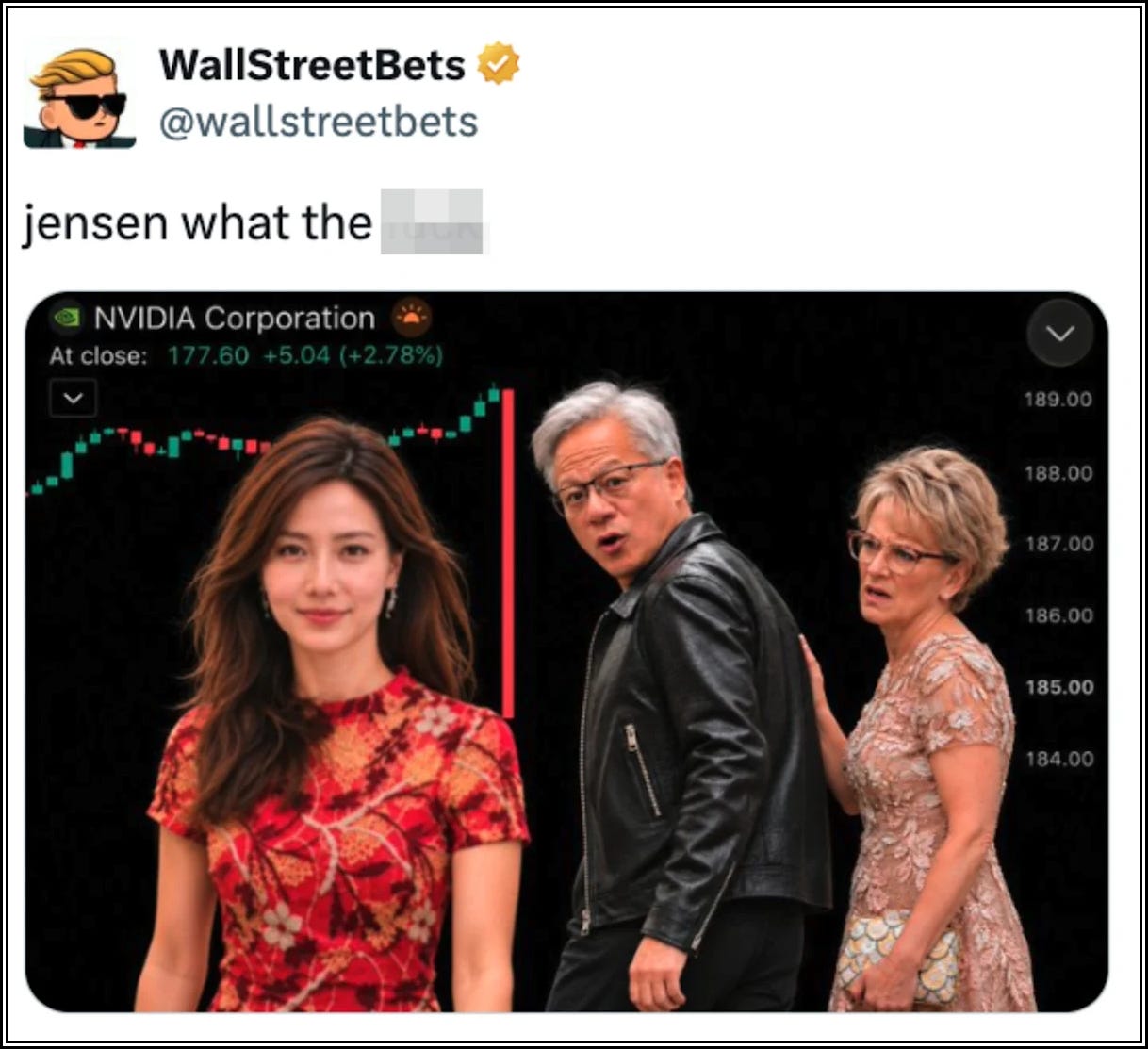
Nvidia entered last week facing a scandal involving the person most closely associated with its success: founder and longtime CEO Jensen Huang. Huang acknowledged an extramarital affair, while reports linked him to a woman U.S. officials suspected of working for Chinese intelligence. The controversy raised questions about whether Huang had been targeted by a foreign intelligence operation and whether sensitive information had been compromised.
On November 8, Nvidia’s board announced an independent investigation, expressed confidence in Huang, and said it had no reason to believe company secrets or national security had been compromised. Four days later, Nvidia announced his resignation and appointed CFO Colette Kress interim CEO. Reports also alleged relationships with other employees. The company promised continuity in its operations and customer commitments, but it now approaches Tuesday’s earnings report without the founder who helped make it central to the AI buildout.
I think Nvidia made a mistake in accepting Huang’s resignation and likely forcing him out. Based on what has been made public, I would have preferred the board to circle the wagons around its founder while completing its investigation. Its initial position gave the company a basis for defending its leader while establishing the facts. I would have wanted a much stronger publicly explained case before accepting the loss of that leadership.
This reminds me of Apple’s decision to fire Steve Jobs in 1985 after his power struggle with John Sculley. After several subsequent leadership changes, Apple approached bankruptcy in 1997, when Jobs returned and helped engineer its recovery. The circumstances differ, but the lesson matters: a company can underestimate how much of its success depends on the vision of the person who built it. Replacing the name on the office door is considerably easier than replacing that vision.
The China angle bothers me as well. The allegations of a foreign intelligence operation remain unresolved. But if Beijing’s objective was to disrupt America’s AI leadership, the departure of the industry’s most influential executive looks to me like an outcome it would welcome. My concern is that we may have helped deliver that disruption ourselves.
Tuesday’s earnings report will give us another test of whether Nvidia’s price action can improve. A correction of nearly 40% may be enough to price in the known negatives. We need to see whether buyers can hold their gains, push through resistance, and begin building higher lows after the report. That improvement would help the broader market recover from this correction. Another burst of strength that quickly gets sold would continue this quagmire.
The opportunity will come from how the stock responds and what follows that response.
Investors have clearly taken the approach of selling first and asking questions later, which I totally understand given Huang’s importance to this company. This man was a rainmaker for his shareholders and the industry at large. His vision, relationships, and ability to get others to commit capital will not disappear because he no longer occupies Nvidia’s corner office. I expect him to land on his feet in time, just as Steve Jobs did. If that comeback happens away from Nvidia, the company could eventually find itself competing against the very person who helped make it so successful.
3) Inflation & Rising Yields Hinder Recovery
October CPI rose 0.4% month over month, with core prices up 0.3%. Headline PPI rose a slightly cooler-than-expected 0.3% for the month, but the annual increase reached 6.5%, its highest since November 2022. One modestly softer monthly reading did not settle the inflation problem.
By Friday, the 10-year Treasury yield was around 5.14%–5.15%, roughly 28 basis points above the previous Friday’s level. Markets are fully expecting a December hike. Those expectations can change, but the direction of the week’s move was unfavorable for expensive growth stocks and businesses that need repeated access to outside capital.
Our familiar sequence remains useful: oil → inflation → Fed → yields → valuations → breadth → price. Oil can retreat from its recent peak without removing the inflation pressure already working through the economy. Higher yields then give investors another reason to question how much they should pay for future growth, particularly when that growth requires enormous spending today.
At these yields, balance sheets deserve more attention. Businesses that fund their own growth have greater flexibility than those that need lenders or shareholders to finance the next stage. Strong demand helps, but interest expense and shareholder dilution can consume a substantial portion of the reward.
Corporate earnings, meanwhile, have remained strong. With 454 S&P 500 companies having reported, 84% exceeded profit estimates and 65% exceeded revenue estimates. Revenue growth was approximately 13.4%, while earnings growth reached 27.4%. Those results offer support for the broader market, but they have not been enough to prevent selling in some of its most important leadership groups.
The practical lesson is to study the reaction as closely as the result. When strong earnings cannot support a stock, investors may already have priced them in or may be assigning a lower value to future profits. We want to see good news produce gains that hold. Until that happens more consistently, strong earnings alone will not resolve this correction.
It is probably a net positive that earnings season is winding down, given this season’s tendency to produce ‘sell the good news’ reactions.
4) Breadth & Price Must Confirm the Recovery
Participation improved this week, but technology remained under pressure. Strength elsewhere gave the market some support, yet persistent selling in its biggest leaders made it difficult for the major indexes to build on the rebound.
A healthier recovery would see financials, industrials, and other groups continue advancing while technology stabilizes. If strength remains concentrated in defensive stocks, it would suggest investors are still looking for shelter. We want broader participation to produce new, actionable bullish plays and help the indexes make sustained progress.
For technology, the first test is whether the Nasdaq Composite, Nasdaq 100, and semiconductor indexes can reclaim their 200-day moving averages. Buyers then need to defend those gains when selling returns. Holding above those averages through a pullback would strengthen the recovery case, while repeatedly reclaiming them only to fall back below would show that sellers still have the upper hand.
S&P 500 (SPX) Decision Levels
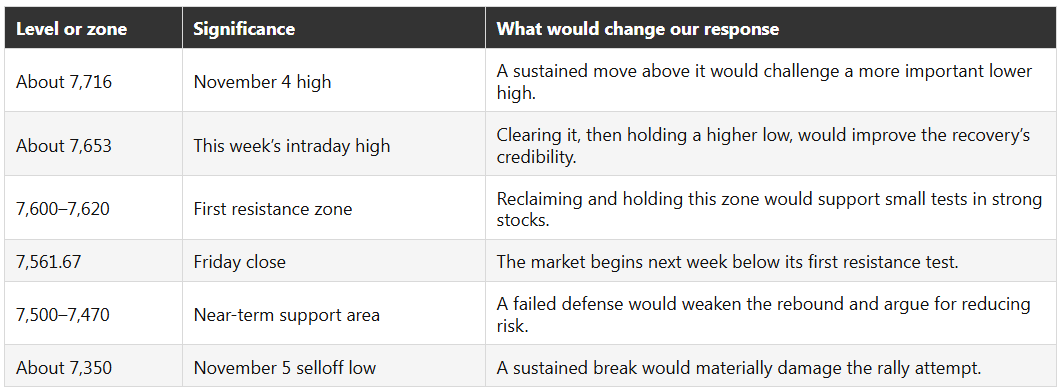
The sequence matters: clear resistance, make progress, and hold a higher low.
That improvement also needs to show up in the stocks we might buy. If the indexes briefly recover while individual setups continue failing, we still have an environment that rewards patience more than aggressive exposure.
5) Next Week Tests AI Demand and Household Spending
Nvidia reports Tuesday, November 17, after the close, with results expected around 4:20 p.m. ET and its conference call at 5 p.m. ET. We will be watching whether the reaction helps repair the damage across technology. A rally that carries into other semiconductor and infrastructure stocks, then holds through subsequent selling, would strengthen the recovery case.
Anthropic’s debut is expected Thursday, November 19. Its preliminary offering terms call for 825 million shares priced between $70 and $78, representing roughly $58 billion to $64 billion in total offering size. That makes this a substantial test of investors’ appetite for AI exposure. We should watch whether the offering attracts fresh capital into the industry or draws money away from existing stocks. An enthusiastic opening would attract headlines (and potential buyers), but the subsequent price action is far more important, as we saw with SpaceX this year.
Retail earnings and Tuesday’s retail sales report will put the consumer in focus. Home Depot and Lowe’s will offer a view of housing-related spending, while Walmart, Target, TJX, Ross, and Gap will provide different perspectives on household budgets and holiday demand. Strong sales supported by heavy discounting would carry a different message from strong sales with resilient margins.
Wednesday’s Fed minutes will cover the October meeting, before the latest inflation reports. They may (or may not) clarify policymakers’ thinking, but the bond market’s response to fresh data will matter more for the recovery. Strong consumer spending could support earnings expectations while also reinforcing concerns that inflation and interest rates will remain elevated.
Next Week’s Key Catalysts
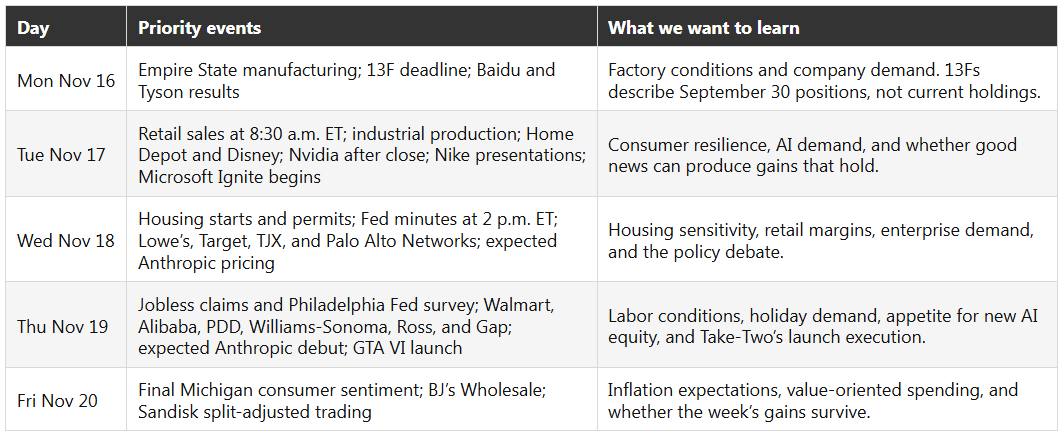
Nike’s presentations and Microsoft Ignite could also produce developments worth watching in consumer brands and enterprise AI. Take-Two’s GTA VI launch will test expectations already built into its shares. Sandisk’s 8-for-1 split may also draw attention, and we’ll be watching closely.
Our job is to watch what the market does with these events. Good news that produces lasting gains would support committing more capital to qualifying setups. Good news that repeatedly gets sold would tell us the correction still has work to do.
I remain 100% cash in my trading portfolio, but I’m preparing for what would get me back in. Below, I share the reversal setups I’m watching, where I’d begin rebuilding exposure, and why I’d start without leverage. I also lay out the scenarios guiding whether I add risk or remain defensive.