

Wednesday, September 9, 2026
Wednesday brought the market directly to the test we have been preparing for.
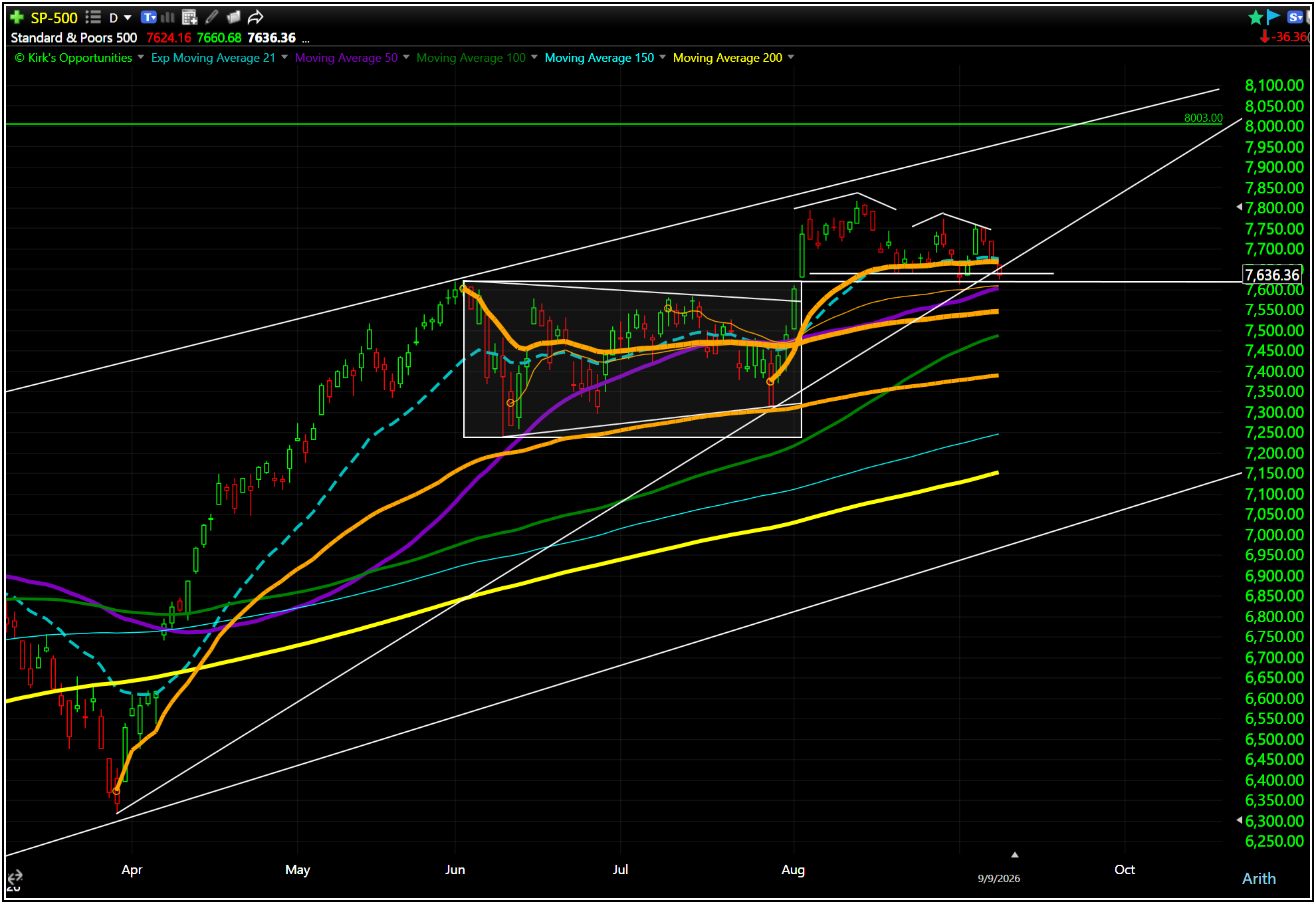
The S&P 500 closed at 7636.36, only 16 points above the 7620 breakout level, while Brent closed above $100, long-term Treasury yields remained elevated and broader participation deteriorated further. Yet Nasdaq 100 continued to hold up better, selected AI leaders attracted capital and Treasury demand remained healthy.
The important question is no longer simply whether 7620 breaks.
It is what happens if it does.
A break followed by sustained selling would strengthen the case that the August breakout has become a bull trap. A break followed by aggressive buying and a quick reclaim could instead create a bear trap and potentially set up another upside reversal.
Thursday’s PPI arrives with the market sitting almost directly on that decision point.
Executive Read
S&P 500: 7636.36: -0.48%
Nasdaq 100: 29460.87: -0.16%
Dow: 52380.66: -0.77%
Russell 2000: 2921.23: -1.32%
VIX: 16.46: +4.71%
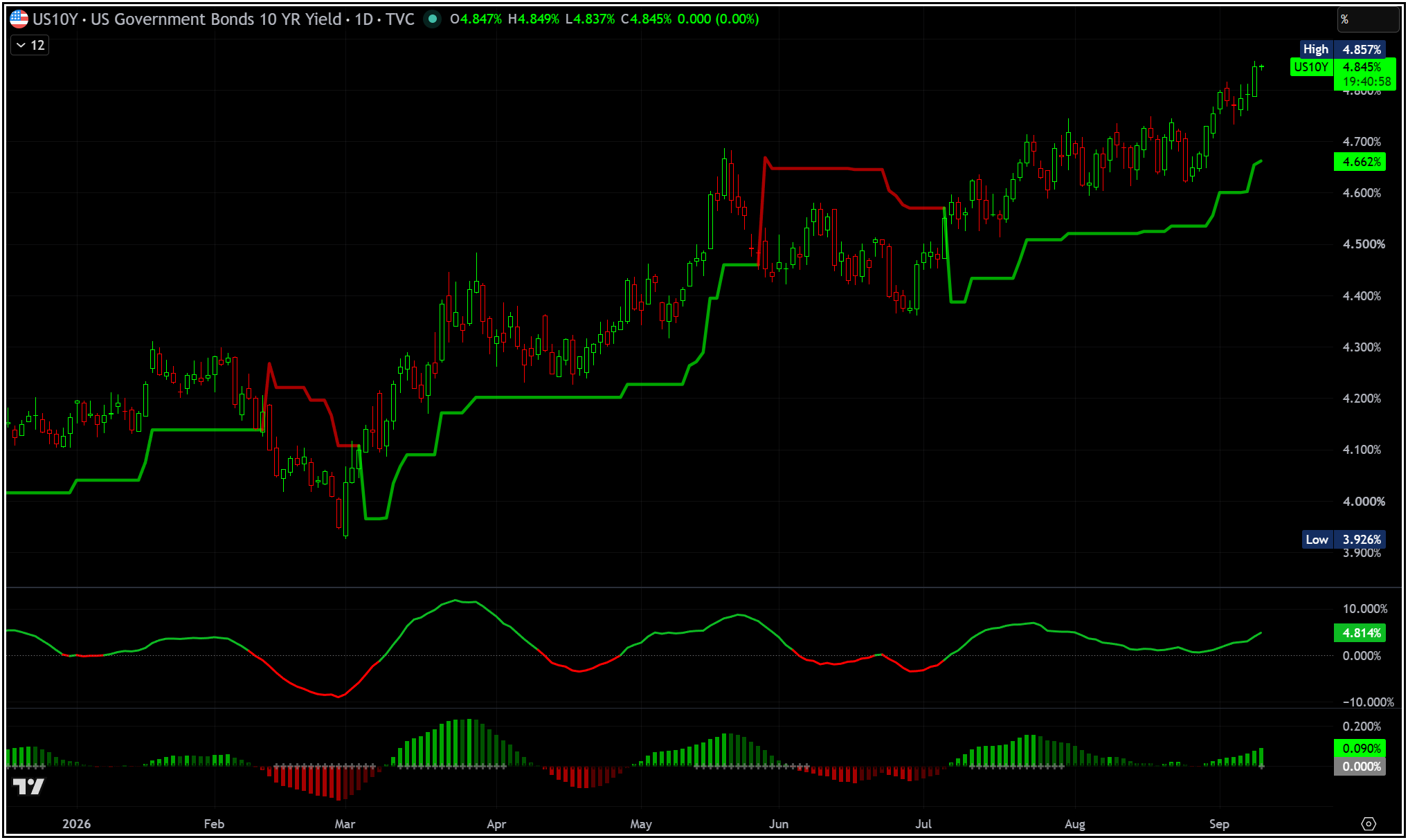
10-year Treasury: 4.84%–4.85%
30-year Treasury: 5.29%
Brent: $101.21
WTI: $96.05
Bias: Cautious, but not yet broadly bearish. 7620 is the level; follow-through is the signal.
Main Market Message
Wednesday brought the technical and macro frameworks together.
Brent crossed $100, the 10-year Treasury remained near 4.85%, breadth deteriorated again and the S&P 500 moved directly toward the August breakout area.
But the full bearish chain has not fired.
The distinction remains:
Elevated oil + stable yields = rotation and volatility.
Higher oil + accelerating yields = a more serious tightening of financial conditions.
Thursday’s inflation report may help determine which environment develops next.
The same principle applies technically.
A move beneath 7620 would not, by itself, confirm that the August breakout failed. The market has already demonstrated that initial breaks and apparent bull traps can fail to generate meaningful downside follow-through.
This time, watch what sellers can do after support breaks.
If price moves below 7620, remains there, rallies fail and selling expands across breadth and leadership, the bull-trap case becomes considerably more credible.
But if sellers push price below 7620 only to have buyers rush back in and reclaim the level, the failed breakdown could become a bear trap.
That is why Thursday should be treated as a confirmation test rather than a prediction exercise.
Market Snapshot
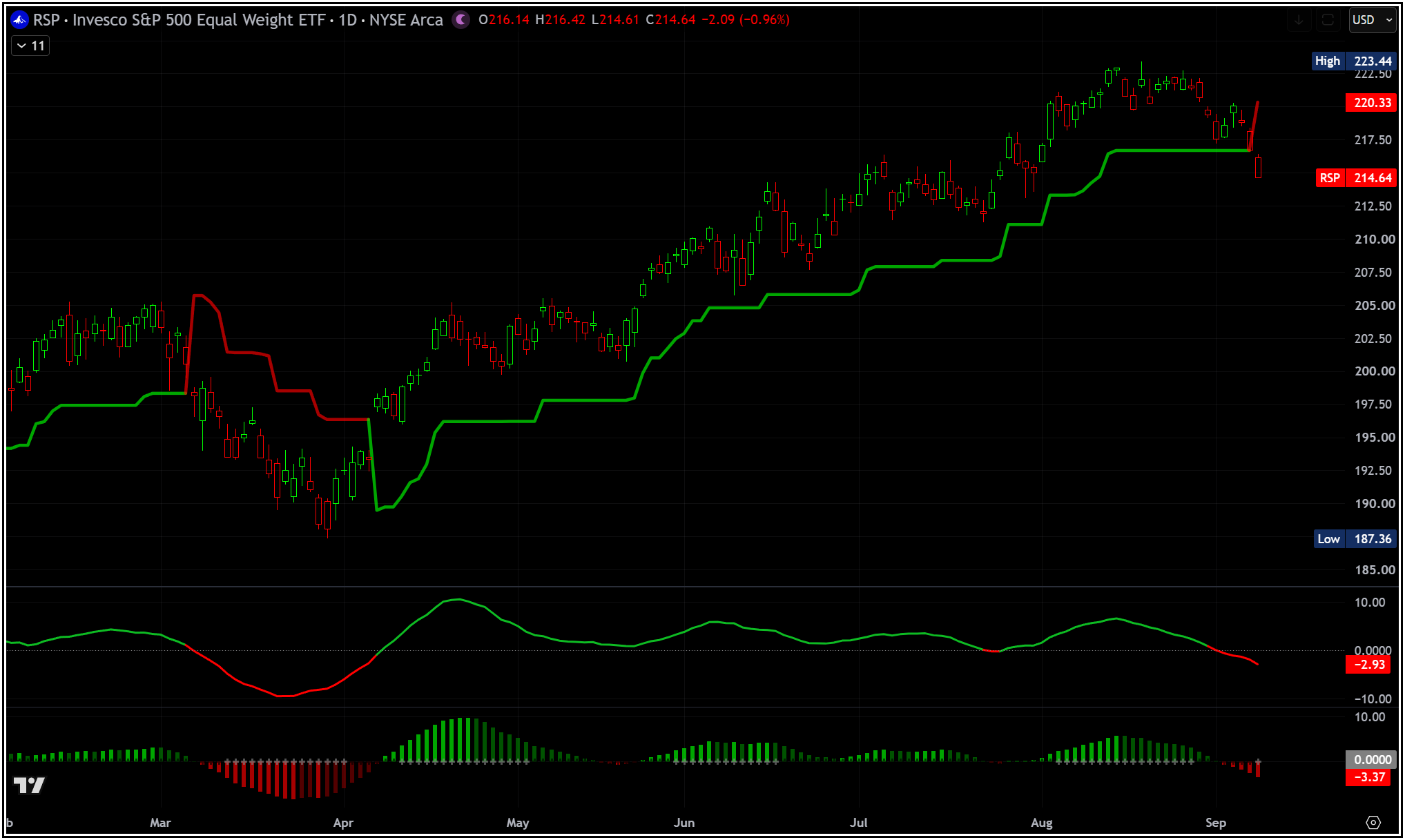
Wednesday’s internals were weaker than the modest S&P 500 decline suggests.
Russell 2000 fell 1.32% into the 2900–2925 support area, and energy was the only S&P 500 sector to finish higher. Small caps, midcaps and equal-weight measures continue telling a weaker story than capitalization-weighted technology indexes.
That distinction remains important:
AI leadership is broadening within AI.
The broader market is not yet broadening with it.
Breadth therefore deserves respect, but not blind obedience. Weak participation describes current market health; it does not automatically predict the next index move.
For Thursday:
Price first. Breadth second. Inflation is the catalyst.
Key Takeaways
1) 7620 is a confirmation test, not a binary line
Three outcomes are possible.
Support holds: Buyers defend 7620 and eventually reclaim 7700.
Bull trap confirms: Price breaks 7620 and sellers produce sustained downside follow-through, including failed attempts to reclaim the breakout.
Bear trap develops: Price breaks support, sellers press the decline, but buyers quickly regain control and force the S&P 500 back above 7620.
The important variable is follow-through.
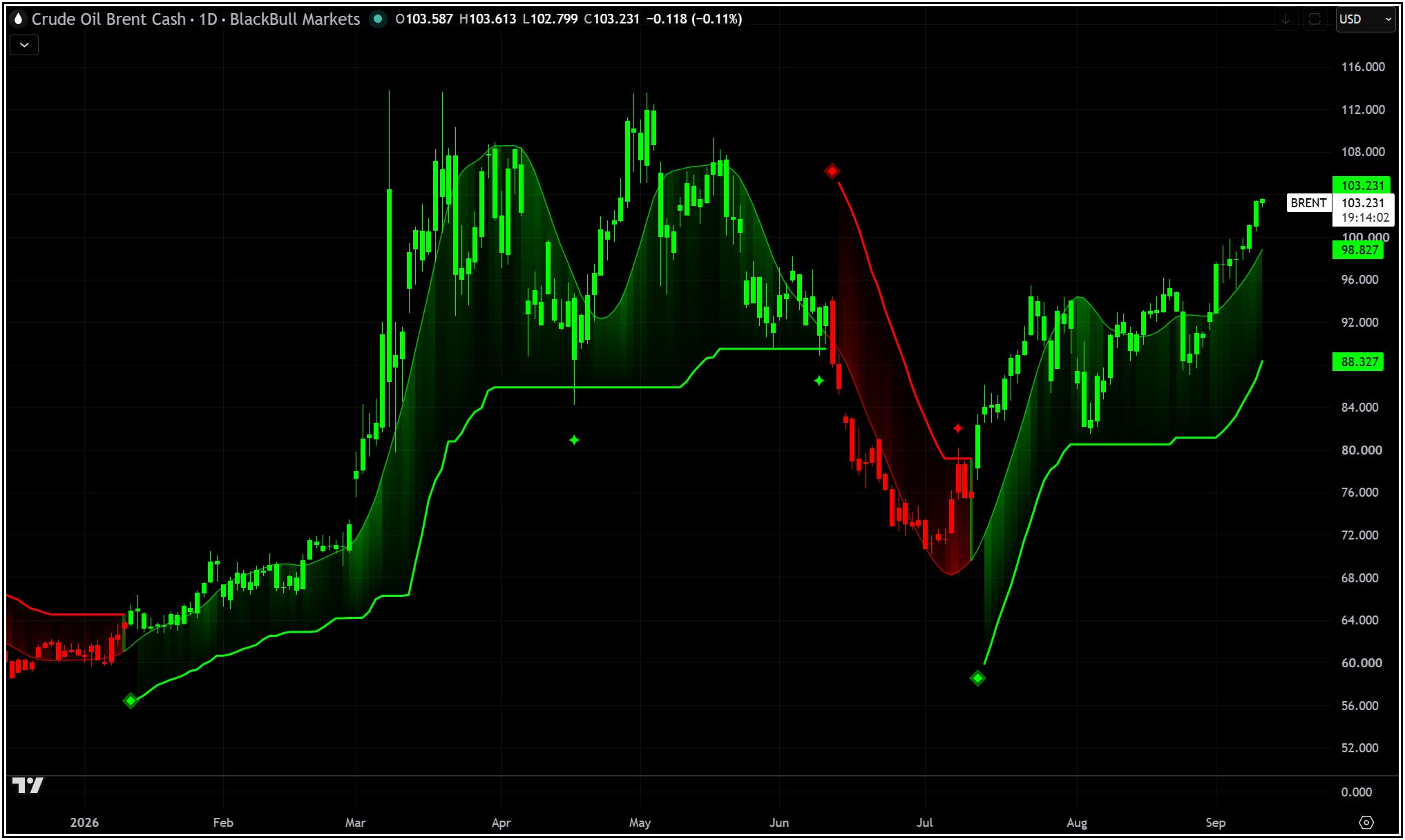
2) $100 oil is now part of the market backdrop
Brent is trading at $103 just before this report has been posted.
The risk is not simply a higher commodity price. It is the transmission mechanism:
Oil → inflation → yields → Fed expectations → valuation pressure
The market can manage elevated oil considerably better if long-term yields stabilize.
3) Breadth continues deteriorating
Russell 2000 has moved from challenging 3000 to testing 2900–2925 in only two sessions.
That is meaningful evidence that tighter financial conditions are affecting the broader market.
But breadth becomes more bearish if it deteriorates alongside an actual failure of 7620 and weakening leadership.
4) AI leadership remains alive
Selected semiconductor and AI names continue attracting capital even as the average stock struggles.
The larger framework remains:
Build → Connect → Power → Secure → Use → Monetize
The easy “own anything AI” phase is giving way to a more useful question:
Where are bottlenecks, scarcity and monetization actually creating durable economic value?
5) September argues for flexibility
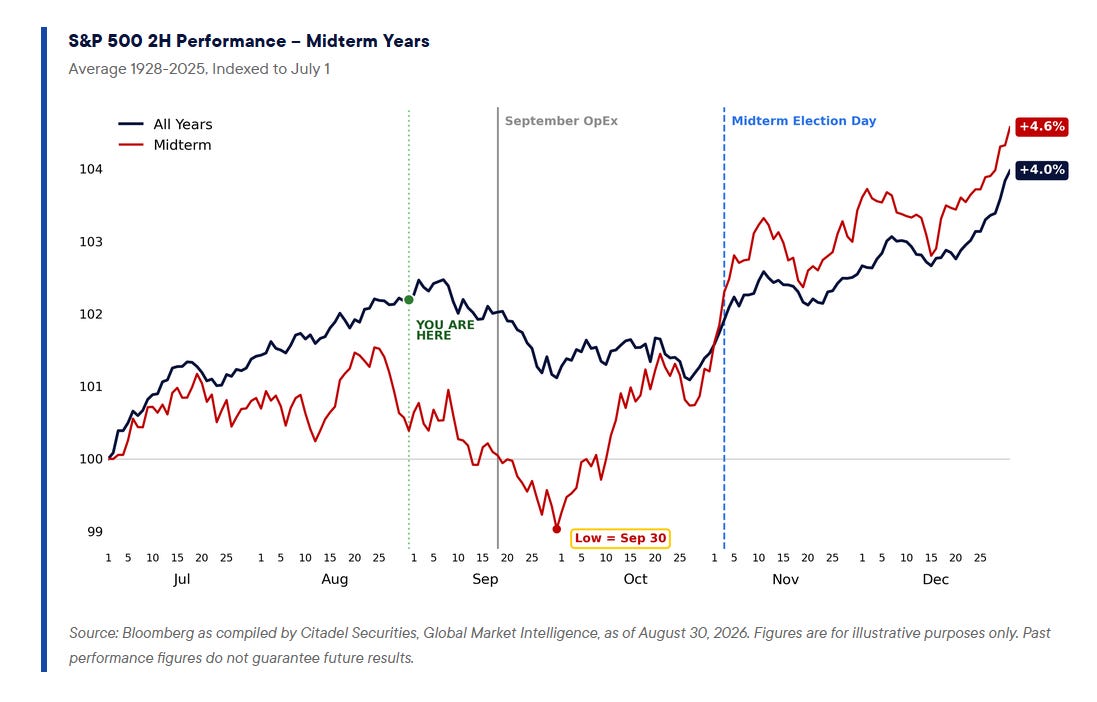
September has historically been a difficult month, but the weakness has tended to become more pronounced in the second half rather than the first.
Seasonality is not a trading signal.
It does suggest that volatility could increase as the month progresses, particularly with inflation data, the Fed and options expiration concentrated ahead.
That makes confirmation more important than anticipation.
AI and Technology
The AI opportunity continues evolving even as the broad market becomes less forgiving.
Build
Semiconductors, memory, equipment and servers remain the foundation.
The opportunity becomes more attractive where capital requirements and limited capacity prevent supply from responding quickly to demand.
Connect
Networking, optics, fiber and interconnect remain among the most interesting emerging areas.
Increasingly powerful AI clusters require extraordinary amounts of bandwidth to move data between processors, racks and data centers.
That keeps QCOM, GLW, LITE, COHR and CIEN high on the research list.
Power
Power is increasingly about more than generation.
The bottleneck includes:
generation → transmission → land → permitting → cooling → community acceptance → data centers
That matters because announced capacity is not the same as deliverable capacity.
Projects can be delayed, become more expensive or never reach their planned scale.
Use and Monetize
META’s strength Wednesday provides another example of the market rewarding a possible bridge between AI investment and actual product monetization.
The strongest full-stack candidates remain MSFT, GOOGL and AMZN, with META and ORCL offering variations.
As AI matures, greater weight should go toward companies that either:
solve a genuine bottleneck
or
capture economics across several layers of the stack.
Businesses dependent on endlessly accelerating hyperscaler capex deserve more scrutiny.
Important Stock Moves
Meta Platforms (META): +6.55%. META stood out in a weak market as investors responded positively to Muse and the possibility that Meta can turn its enormous AI investment into products distributed across its existing ecosystem.
Alphabet (GOOGL): -2.3%. Another major AI-infrastructure commitment was met with selling, reinforcing the market’s growing demand for evidence that enormous capex eventually produces attractive revenue growth, margins, free cash flow and return on invested capital.
Apple (AAPL): modestly lower. The product event did not produce a significant positive revaluation. Investors still appear to be waiting for stronger evidence that Apple Intelligence can create a meaningful upgrade cycle or earnings catalyst.
Advanced Micro Devices (AMD): higher again. AMD continued showing relative strength despite deteriorating broad-market conditions.
Qualcomm (QCOM): +1.3%. Tuesday’s Amazon-related strength received another day of follow-through, a useful sign that the catalyst has not immediately faded.
Broadcom (AVGO): -1.13%. AVGO pulled back after recent strength. For now, the decline looks more like consolidation than thesis deterioration.
ServiceTitan (TTAN): sharply lower. The punishment for weaker forward expectations continued despite solid reported results.
The lesson remains:
Good current numbers provide little protection when expectations for what comes next deteriorate.
Sector Leadership
Wednesday’s sector message was uncomplicated:
Energy led. Everything else struggled.
That is not the participation profile normally associated with a durable broad-market advance.
Technology remains much more selective. Some AI and semiconductor names continue working while other mega-cap and software stocks weaken.
The result is a stock-picker’s market rather than a broad risk-on market.
The investment implication is not to abandon equities.
It is to require more evidence before committing capital outside genuine leadership.
Rates / Fed / Volatility
The 10-year Treasury yield remained near 4.84%–4.85%, while the 30-year approached 5.29%.
The Treasury market is stressed, but demand has not disappeared. Wednesday’s 10-year auction attracted healthy demand, suggesting investors are still willing to own long-duration government debt at sufficiently attractive yields.
Thursday brings two additional tests.
PPI determines whether incoming inflation data reinforce or interrupt the oil-to-yields transmission mechanism.
The 30-year Treasury auction tests long-duration demand again.
The preferred sequence is:
Inflation cooperates → yields ease → pressure on equities decreases
The more difficult sequence is:
Inflation firms → yields accelerate → $100+ oil compounds the problem
That second sequence would make a break of 7620 considerably more difficult for buyers to reverse.
Commodities and Dollar
Oil has entered a more difficult range.
Brent: $101.21
WTI: $96.05
The working framework:
Below $100: improving
$100–$105: macro pressure remains elevated
$105–$110: stronger inflation and valuation pressure
$110–$120: increasingly stagflationary
Energy should not be treated as one trade.
A better approach is to follow the profit chain:
Supply disruption → higher crude → higher gasoline/diesel → refining margins → earnings → cash flow → dividends/buybacks
Producers, refiners and midstream companies can respond very differently to the same crude-oil move.
If oil remains elevated, refining economics deserve additional research.
Crypto
Bitcoin remains around the upper-$78000 area without providing a meaningful new liquidity signal.
Immediate support: 78000
Secondary support: 75000–76600
Resistance: 80000
Major resistance: 81200–82000
Crypto remains secondary to oil, inflation and Treasury yields for now.
Technical Picture
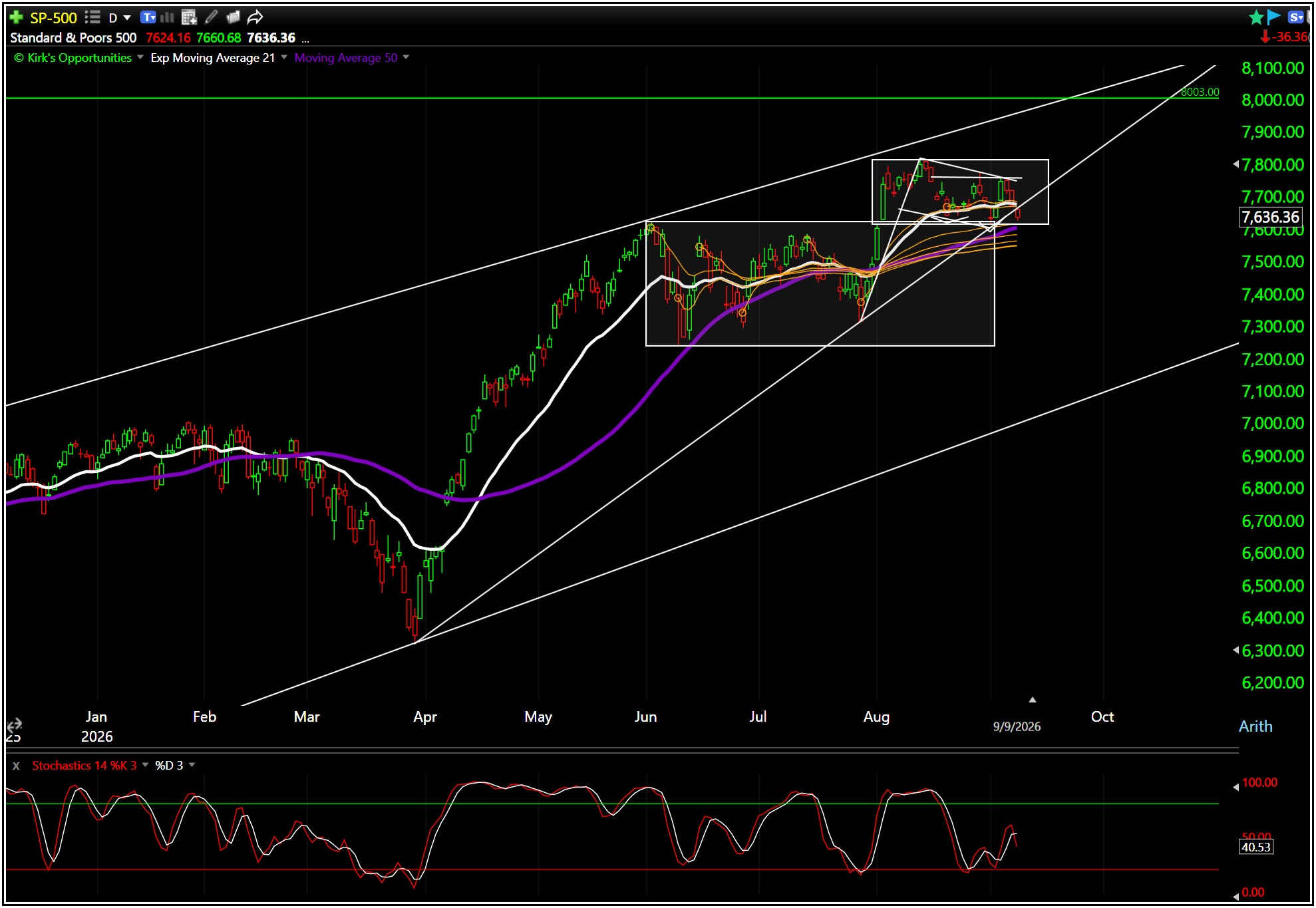
S&P 500 / SPY
Close: 7636.36
Critical support: 7620
Secondary support: 7550–7500
First resistance: 7700
Major breakout: 7816
Measured objective: 8003
This is the centerpiece of Thursday’s setup.
The S&P 500 is returning to the area that defined the August breakout.
But a break beneath 7620 is not enough to confirm a bull trap.
Path 1 — Support holds
Buyers defend 7620 without permitting a meaningful breakdown.
A reclaim of 7700 would begin repairing the short-term structure.
Path 2 — Bull trap confirms
Price breaks 7620 and sellers retain control.
Watch for:
sustained trading beneath 7620
weak rebounds
failed attempts to reclaim support
worsening breadth
leadership beginning to fail
That would provide the downside confirmation previous bull-trap attempts lacked.
Path 3 — Bear trap develops
Price breaks 7620, sellers press the weakness and buyers then rush back in.
Watch for:
quick reclaim of 7620
strong close back above the breakout
follow-through buying
improving breadth
That would suggest the breakdown trapped sellers rather than bulls.
The working roadmap therefore becomes:
Bullish:
7620 holds or is quickly reclaimed → 7700 → 7816 → 8003
Bearish:
7620 breaks → reclaim fails → sustained downside follow-through → 7550–7500
7620 is the level. Follow-through determines the message.
Nasdaq 100 / QQQ
Close: 29460.87
Immediate support: 29400–29500
Secondary support: 29000–29200
Major resistance: 30000
Nasdaq 100 continues showing relative resilience.
A successful defense of current support would keep the growth-leadership argument intact.
A loss of 29000–29200 would indicate that weakness is spreading farther into large-cap growth.
Russell 2000 / IWM
Close: 2921.23
Current support: 2900–2925
First reclaim: 2950
Major resistance: 3000
Small caps are already testing secondary support.
A defense of 2900 followed by a reclaim of 2950 would help stabilize breadth.
A decisive break below 2900 would add another piece of confirmation if the S&P 500 simultaneously loses 7620.
Quality of the Move
Wednesday’s decline was weaker in quality than Tuesday’s.
Oil crossed $100, long-term yields remained elevated, small caps reached secondary support and participation deteriorated further.
But several mitigating signals remain:
7620 held.
Nasdaq 100 remains relatively resilient.
Treasury demand remains healthy at current yields.
Selected AI leaders continue attracting capital.
The takeaway is not that breadth should be ignored.
It is that breadth should be used as confirmation.
Price first. Breadth second. Inflation is the catalyst.
Everything above gives readers the market story, technical setup and major themes.
Everything below answers the higher-value questions:
What are the probabilities?
What would change them?
How should exposure respond?
Where are the opportunities?
