


The Bottom Line
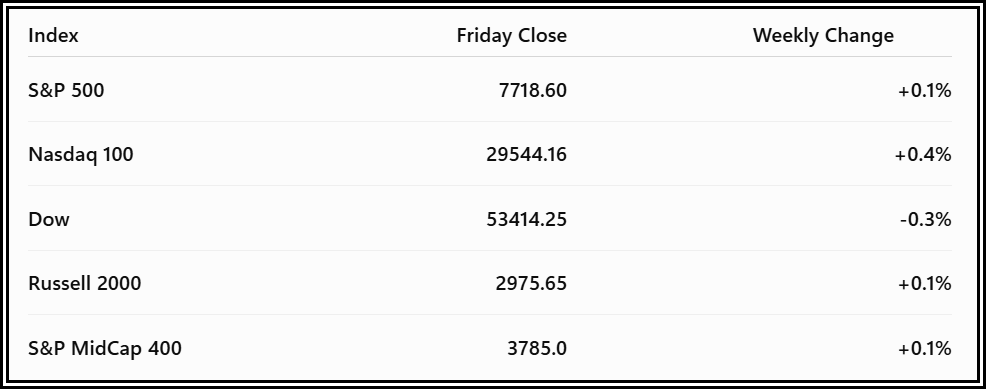
This was a much more consequential week than the nearly unchanged indexes suggest.
Stocks had to overcome renewed U.S.-Iran fighting, sharply higher energy prices, another global bond selloff, rapidly shifting Fed expectations and a surprisingly much stronger-than-expected jobs report. Despite all of that, the S&P 500 finished slightly higher for the week and only about 1% below its August record high at 7816.
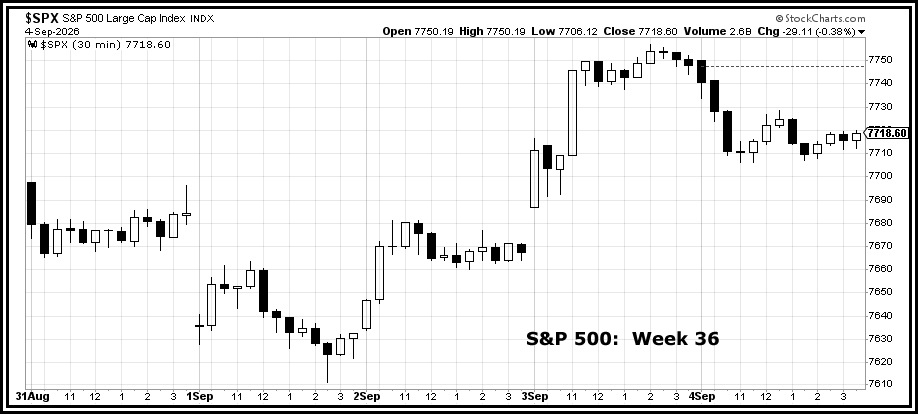
More important, the technical damage attempted early in the week did not stick. The S&P briefly moved below the June 2 breakout level at 7620 Tuesday but very quickly recovered, stabilized Wednesday and then rallied +1.06% Thursday as yields fell and expectations for another Fed hike declined. Friday’s strong jobs report revived hike expectations, but once again failed to produce significant follow-through selling.
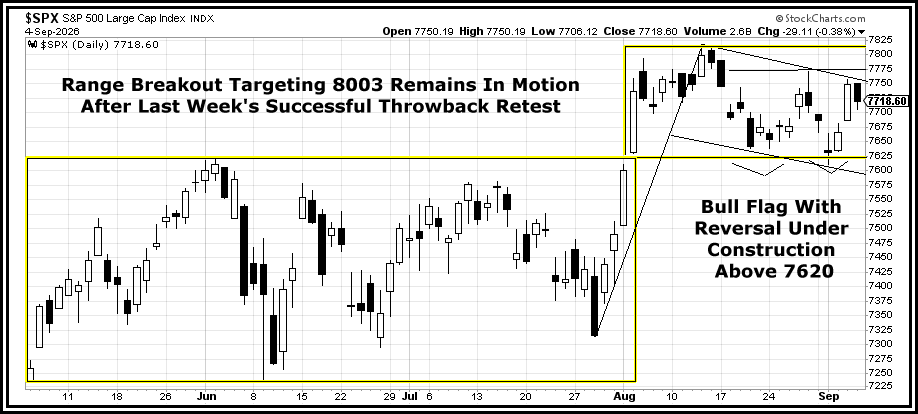
For the record, five of the past six weeks have now finished higher, refusing to fall more than 2% from its prior high.
The summer breakout survived its first major throwback retest, and the lower rising trend line held as well. That keeps the range breakout play in motion along with its target at S&P 8003.
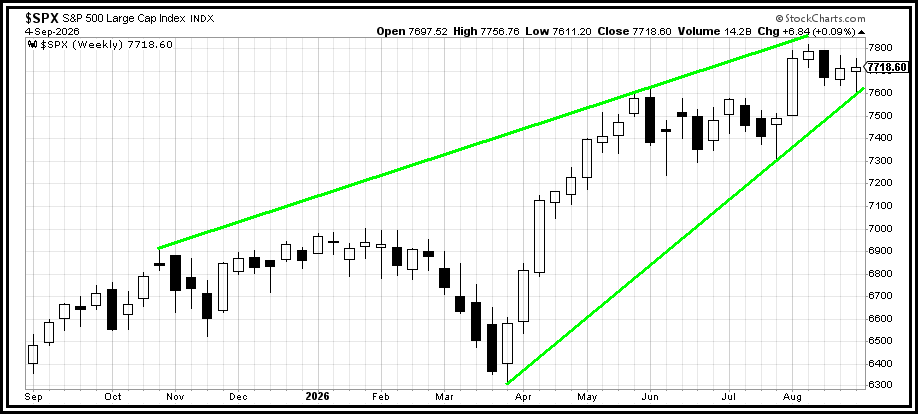
The bears had plenty working in their favor this week and couldn’t do much with it. While this does not make the market bulletproof, it raises an obvious question: what happens if some of those headwinds begin reversing?
For now, I enter the shortened week ahead cautiously constructive. The intermediate-term evidence remains bullish, but energy prices, Treasury yields, inflation and weakening breadth are some of the collective challenges we face as the Fall trading season begins after Labor Day.
The indexes essentially went nowhere despite a difficult macro backdrop. For now, that looks more like consolidation than deterioration, at least from the index perspective.
Stress Testing
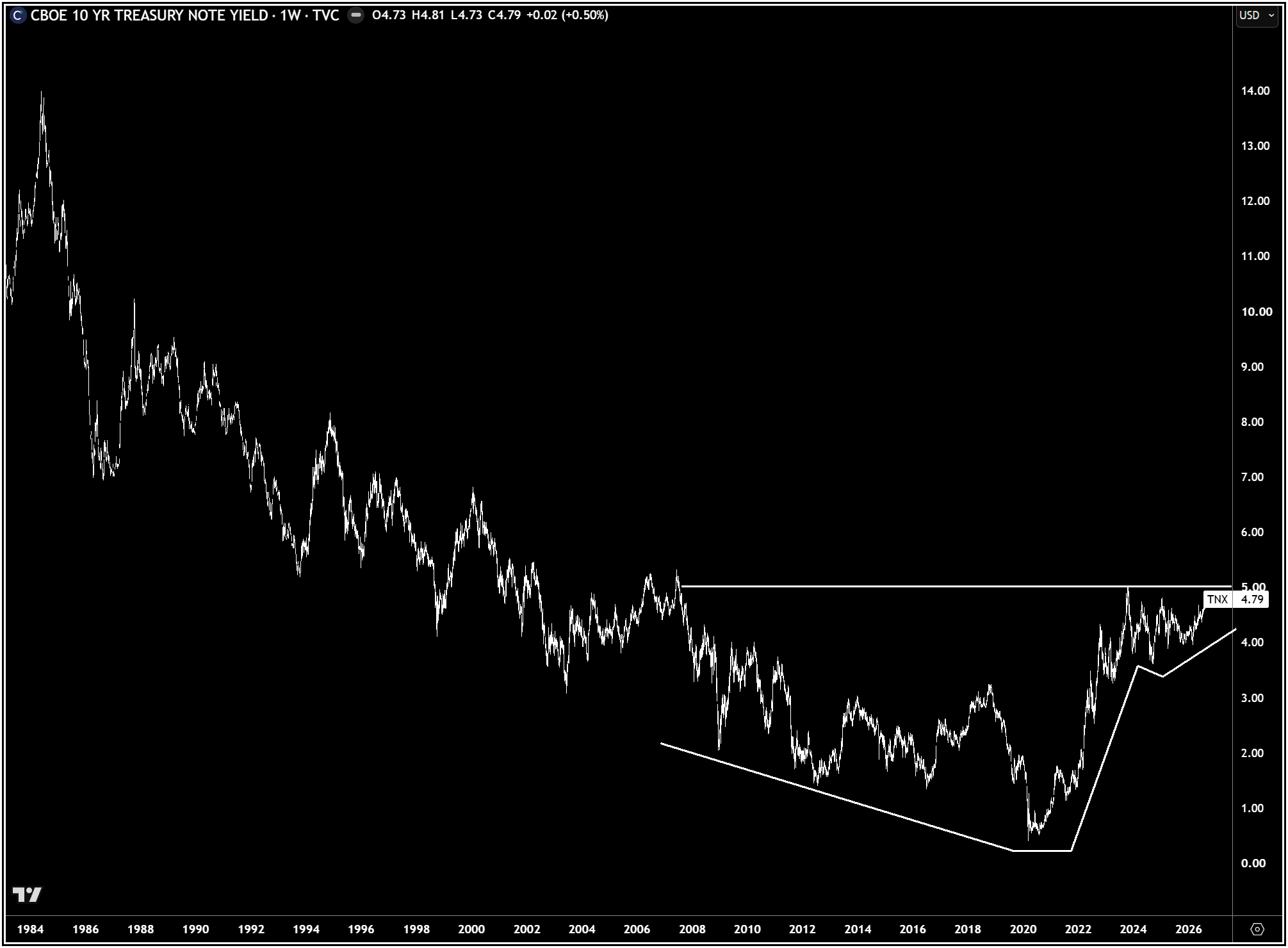
The week opened with renewed U.S.-Iran escalation, higher oil, rising Treasury yields and increasing expectations for another Fed rate hike. Those pressures intensified Tuesday as the 10-year approached 4.8% and the S&P fell to 7611, briefly breaking the important 7620 breakout level before recovering.
That became the pivotal move of the week. The market had an opportunity to turn the summer breakout into a failure and refused.
Stocks stabilized Wednesday, and Thursday brought the response bulls wanted. Christopher Waller indicated he could support holding rates steady if incoming inflation data confirms continued disinflation. Bond yields retreated, rate-hike expectations fell and the S&P jumped 1.06%, its strongest daily gain in about a month.
Then Friday delivered the week’s final test. August payrolls increased 162000, unemployment remained 4.1%, and earlier months were revised higher. The stronger labor picture pushed September hike expectations back toward 60%, but stocks still suffered only modest damage.
The takeaway is fairly straightforward: the labor market is healthier than feared, and the market is proving harder to knock over than the macro headlines would suggest.
The Fed, Energy and Treasury Yields
Until recently, investors were primarily asking whether economic weakness would eventually force the Fed to ease. That debate has changed. Now the question is whether inflation remains high enough to justify another hike despite an economy that continues to hold up reasonably well.
That puts next week’s inflation reports directly in control of the near-term policy discussion.
Energy and Treasury yields are part of the same equation. Higher energy costs feed inflation concerns, which can keep yields elevated and strengthen the case for tighter policy. And the risk is no longer simply whether crude reaches $100. Diesel and other refined products deserve attention because they feed more directly into transportation, agriculture and industrial costs.
For now, the simplest way I see the near-term market is that stocks are trading largely opposite energy prices and Treasury yields. The market may be able to absorb one moving higher while the other stabilizes. If both keep rising, eventually something probably gives. If both begin falling, one of the market’s biggest headwinds quickly becomes a tailwind.
I continue to watch 4.82%–4.85% on the 10-year as the immediate resistance area. Beyond that, 5% is the line that could really get the market’s attention, putting in a significant higher high from a higher low.
Will The Magnificent 7 Lead Again?
Leadership remains uneven. Semiconductors have held up reasonably well, software has been much more volatile, and the broader tape still lacks the kind of persistent participation normally seen during the strongest advances.
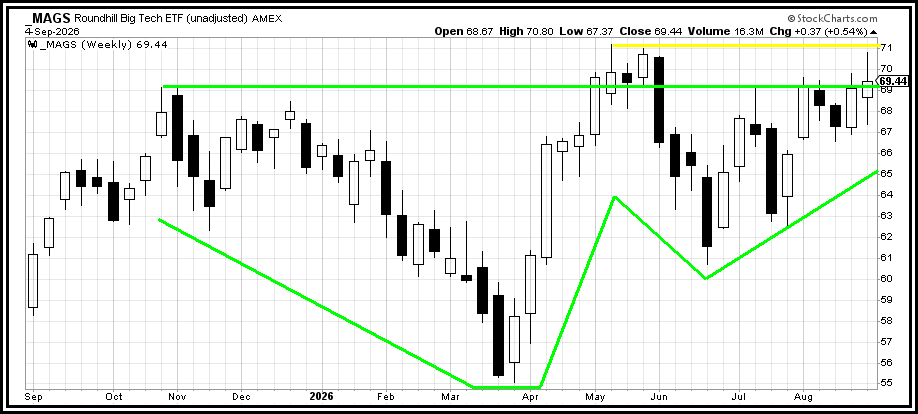
That makes MAGS one of the most important charts I am watching.
The Magnificent 7 has spent roughly 10 months consolidating. Ten months is a long time for the market’s biggest guns to sit on the sidelines. If MAGS finally breaks out, the indexes may suddenly have considerably more horsepower.
There is another reason to pay attention.
AI-related leadership has been surprisingly resilient during the rate shock. Higher long-term rates should have created far more trouble for expensive growth stocks than they actually did. Instead, much of the group consolidated rather than broke down.
If something refuses to break under conditions that should have broken it, pay attention.
The weekend added another supportive signal. Foxconn said third-quarter performance should exceed expectations as AI demand remains strong, while August revenue reached a record. That does not guarantee an MAGS breakout. But if inflation cools, yields retreat and MAGS finally escapes its long range, the market could get a macro catalyst and a leadership catalyst at the same time.
Below, I lay out the exact S&P levels that determine whether 8003 remains in play, what I need to see from breadth and momentum, the scenarios I am assigning for next week, and where I am seeing the best opportunities beyond the major indexes.
