


Wall Street rolled out the red carpet Thursday for the biggest initial public offering in history. Anthropic arrived with an $81 billion offering, a valuation briefly exceeding $2 trillion, and enough excitement to remind everyone why artificial intelligence has captured the investing world’s imagination.
By the closing bell, the red carpet looked more like an emergency exit.
The S&P 500 suffered its sixth consecutive decline, the Dow plunged more than 1,100 points, and more than 90% of S&P 500 stocks finished lower. Even Anthropic’s historic debut couldn’t convince investors to stop selling.
But the most important development wasn’t the size of Thursday’s decline. It was the market’s inability to sustain an enthusiastic opening rally despite having almost every excuse to do so.
That tells us something about the market’s character. And for those of us preparing to put capital back to work, understanding that change matters far more than guessing where the next bottom might be.
The encouraging part? Selling pressure is becoming sufficiently extreme to create the conditions for a potentially powerful rebound. The frustrating part? We still don’t have convincing evidence that buyers can sustain one.
Our posture remains defensive, patient, and increasingly alert for the next opportunity. We want to be ready to buy, but we don’t need to be first.
1. Damage Report & Price Action
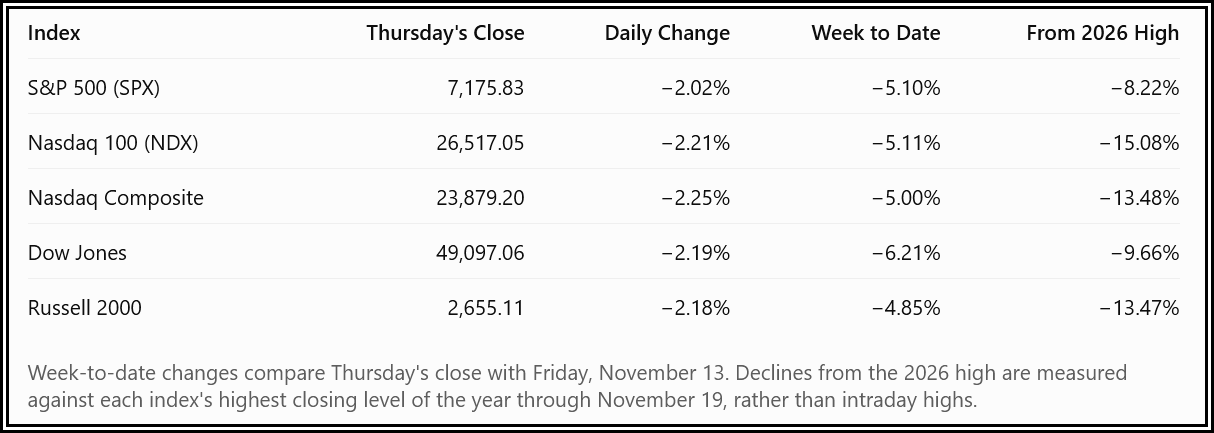
The S&P 500 is now 8% below its October record and has declined 5.1% this week, with Friday still to come. Thursday’s close was its lowest since April.
Those statistics are certainly unpleasant. But they don’t fully capture what happened.
The S&P 500 reached 7,415.64 before collapsing to 7,173.63, an intraday reversal of nearly 242 points. It finished just 2.20 points above its low.
The Nasdaq experienced a similar rejection.
Think about what that means. Buyers arrived with enthusiasm, prices moved higher, and for a brief period the market appeared ready to stage a bounce. Then sellers overwhelmed the advance and pushed the indexes to their lows.
The bulls didn’t merely lose Thursday’s session. They lost control of a rally they had already started.
And that’s a much more important warning than a routine 2% decline.
As for the slow train wreck this market has become, the bearish double-top reversal play has proven successful, moving and closing in its 7198-7170 target zone.
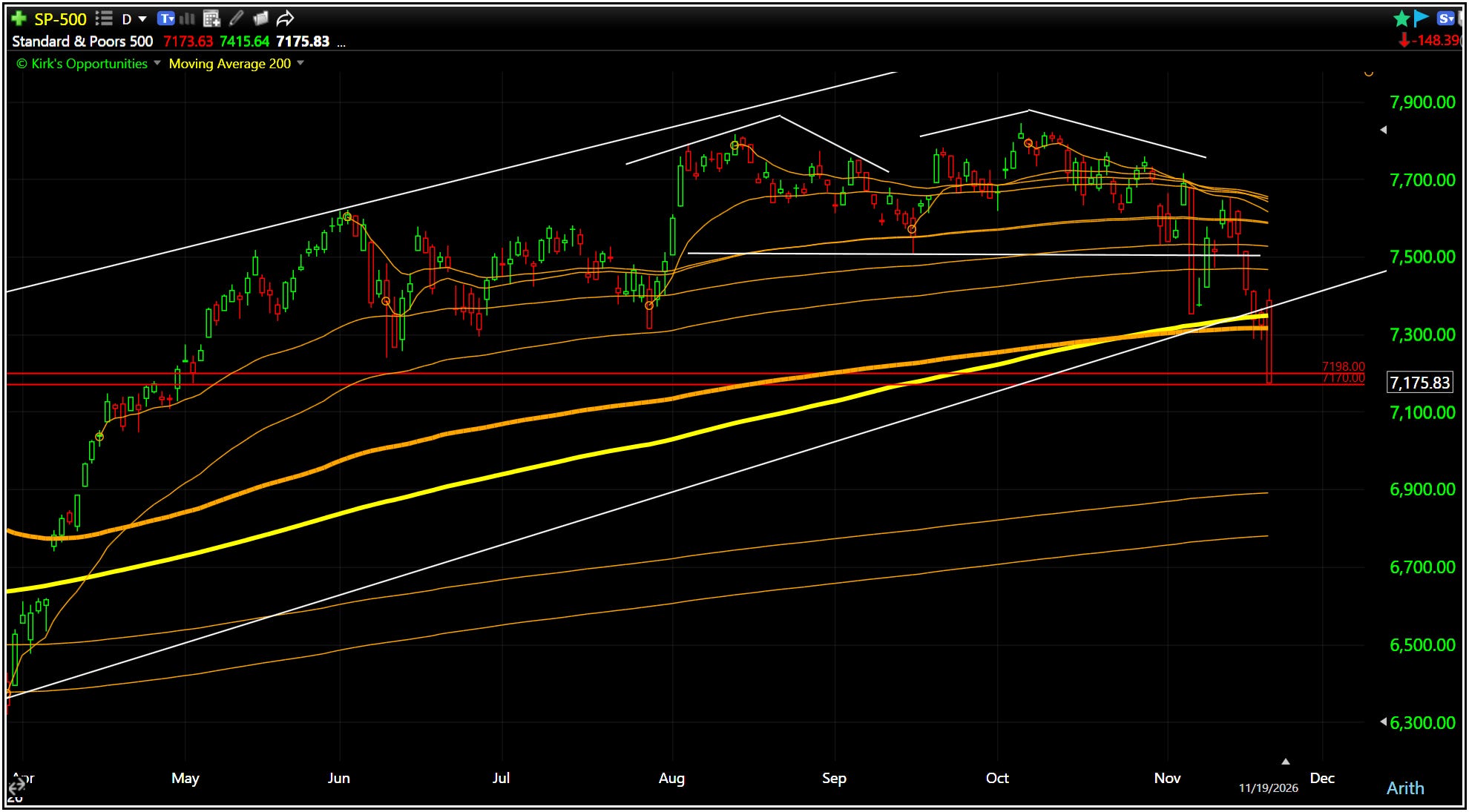
This target capture has broken the lower trend line, which is drawn from the past two April correction lows.
Additionally, and more importantly, we have a new, head and shoulders reversal play targeting 6856-6782 so long as price holds below the neckline and its 200 day moving average.
A target zone just below the January 7002 high.
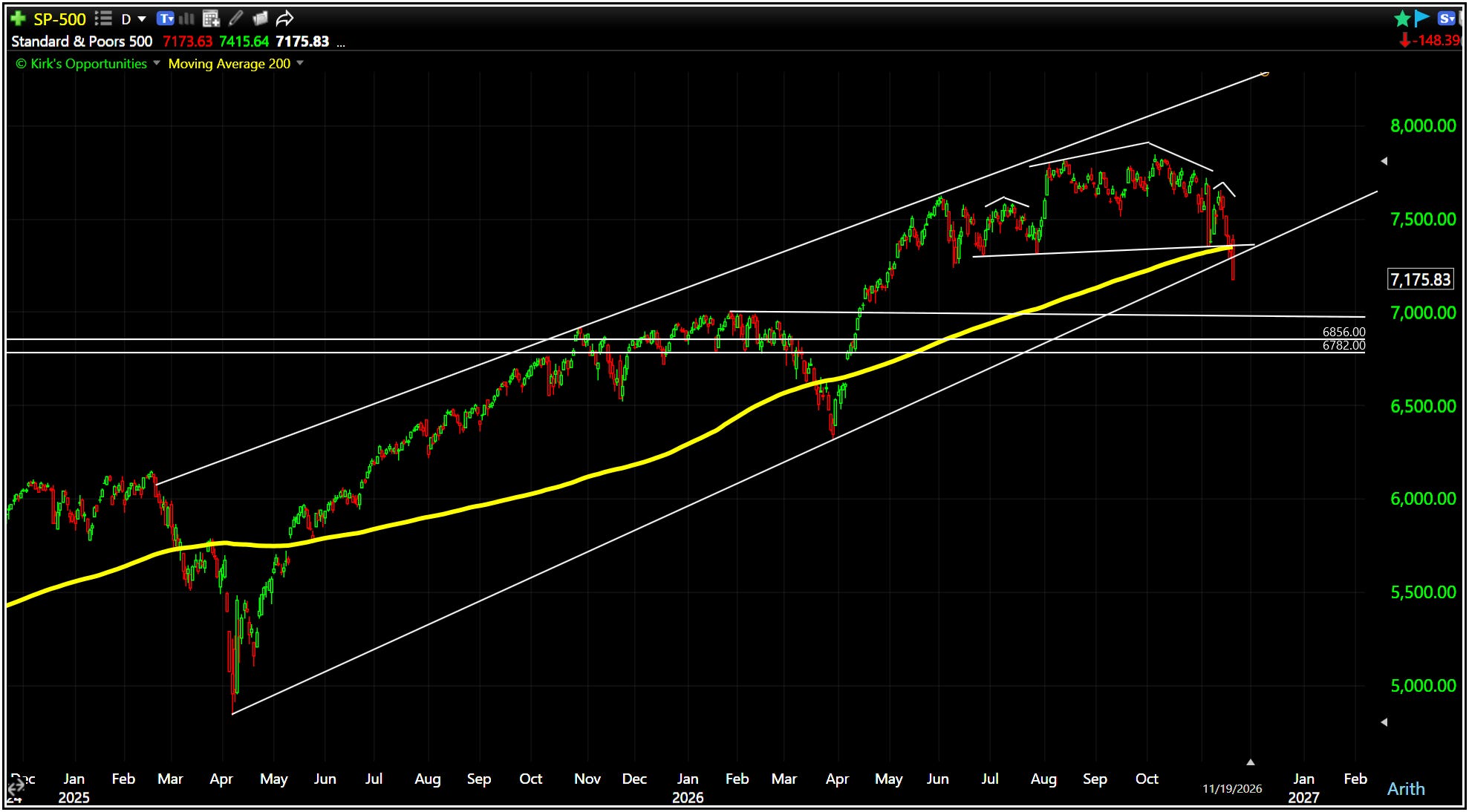
To say the least, the bears have gained the advantage and the best opportunity in some time to rack up more losses (and profits for them) before this correction is over.
Tomorrow our focus will be as it has been throughout, risk management and patience.
I remain in a 100% cash position and, while I’m watching closely for an opportunity to put money to work again, the price action as you see is simply not providing it.
2. What Mattered Most
1) Anthropic made history. The AI trade still couldn’t find its footing.
Anthropic’s IPO was extraordinary by almost any measure.
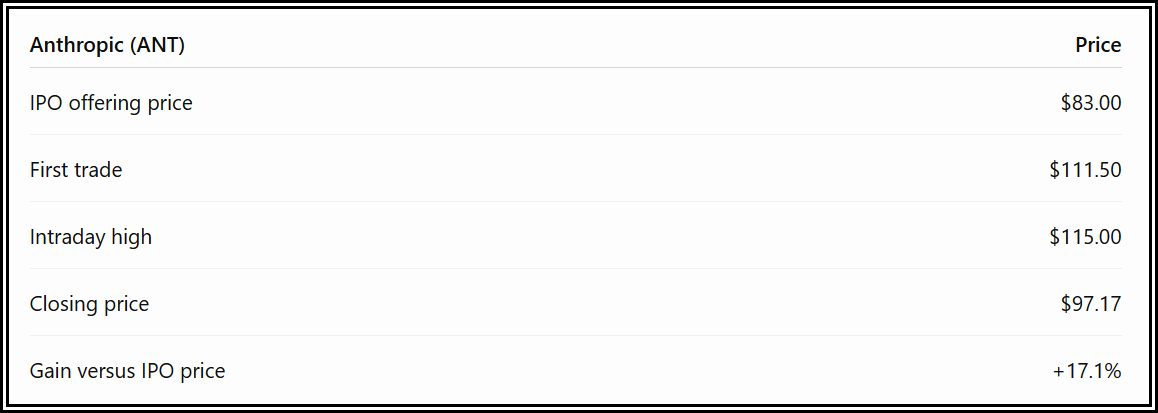
For a company that has become one of the most important names in artificial intelligence, Thursday represented a remarkable achievement.
But there’s another side to this story.
Anthropic finished almost 13% below its opening price, surrendering a substantial portion of its initial premium. Meanwhile, many established AI companies suffered another round of selling.
One possible explanation is that investors sold existing technology holdings to finance purchases of Anthropic. That may have contributed to the pressure, but it doesn’t fully explain the broader weakness.
The bigger issue is that investors are reconsidering the economic assumptions supporting the entire AI investment cycle. Even its most ardent users and investors.
AI’s extraordinary potential isn’t necessarily in dispute. What is increasingly being questioned is how much investors should pay for that potential, how much capital must be invested to realize it, and which companies will ultimately earn attractive returns.
A great technological revolution doesn’t guarantee that every company financing it will be a great investment.
Anthropic’s debut may mark another stage in the market’s transition from rewarding AI exposure indiscriminately to demanding proof of economic value.
What we’re watching: Can Anthropic establish support above its offering price while established AI leaders begin stabilizing? Or will enthusiasm for the newest AI opportunity continue alongside weakness in the companies that led the previous advance?
2) Nvidia’s problem has become the broader market’s problem.
Nvidia declined another 3.3% Thursday, extending its losing streak to six sessions.
Its encouraging revenue forecast has not been enough to overcome uncertainty surrounding the leadership transition, valuation, and the future economics of AI infrastructure.
And Nvidia is hardly alone.
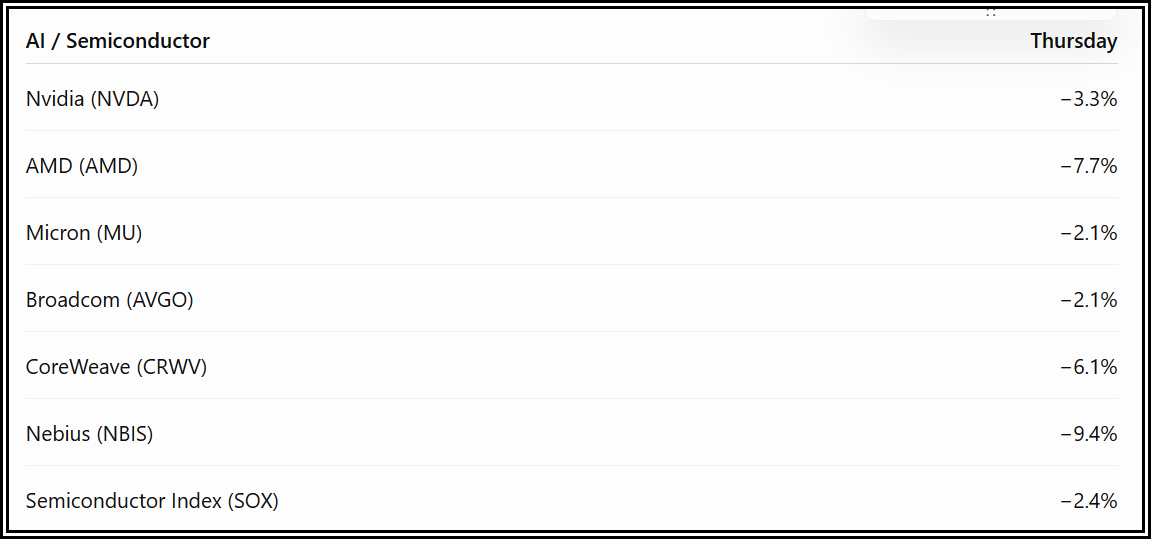
AMD’s decline followed allegations from Hunterbrook Media about certain China-related business relationships and possible export-control scrutiny. AMD disputed the allegations and reaffirmed its compliance with U.S. rules. The claims have not been independently established.
That distinction matters. But so does the market’s immediate reaction.
When confidence is strong, investors may give companies time to address uncertainty. When confidence deteriorates, uncertainty itself can become a reason to sell.
More broadly, we’re watching a transition in how the market values the AI ecosystem.
For much of the bull market, investors rewarded companies for announcing bigger capital expenditures, larger infrastructure commitments, and increasingly ambitious AI plans.
Now the questions are changing.
Where are the returns? How will the spending be financed? What happens if borrowing costs remain elevated? And which companies can generate enough cash to fund growth without repeatedly returning to capital markets?
This helps explain why even strong earnings can be followed by disappointing stock performance.
Business fundamentals can improve while stock prices decline if investors are simultaneously lowering the multiples they’re willing to pay.
That’s the distinction we must respect.
For a sustainable market recovery, we want more than Nvidia simply stopping its decline. We want improvement across semiconductors, infrastructure businesses, and other former leaders.
The market will have a much easier time recovering if its largest former winners begin participating rather than acting as anchors.
3) The breadth deterioration is becoming difficult to ignore.
Perhaps the most troubling development Thursday wasn’t the weakness in the indexes. It was what happened underneath them.
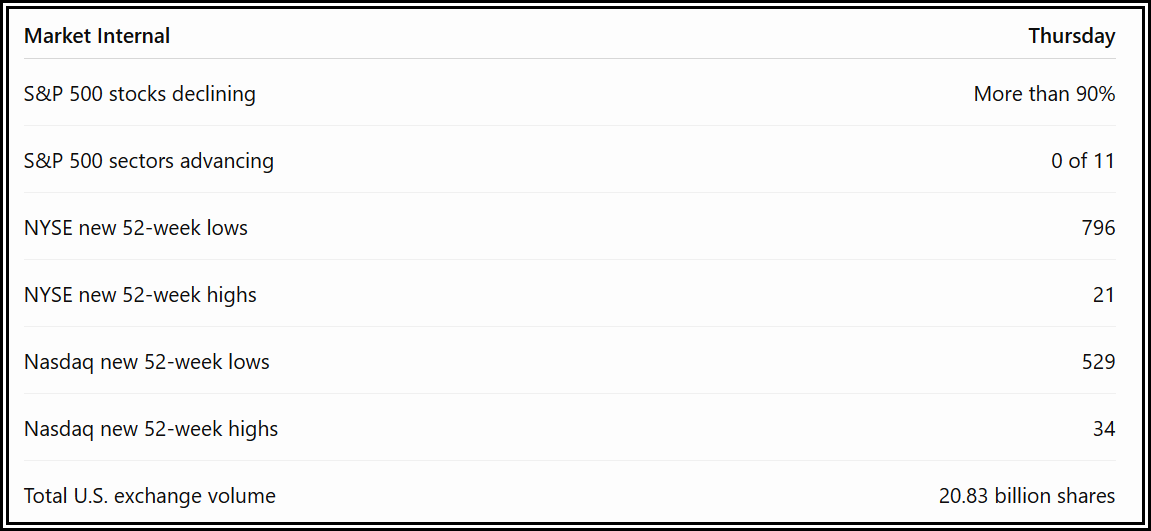
Trading volume exceeded the recent 20-session average of approximately 19 billion shares.
In other words, the selling was widespread and occurred on elevated volume.
This wasn’t simply a few enormous technology companies dragging down otherwise healthy indexes. Investors were reducing exposure across a broad range of industries.
That suggests the market’s problems have moved beyond an isolated correction in AI-related stocks.
However, there’s an interesting complication.
The more widespread selling becomes, the closer we are moving toward an exhaustion point. Even full-bull capitulation.
When almost everything is declining, selling pressure can become stretched enough to produce sharp rebounds. The challenge is determining whether those rebounds reflect genuine accumulation or simply temporary relief from relentless selling.
That’s why breadth must play a central role in our confirmation process.
We want fewer new lows, materially stronger advance-decline readings, and evidence that money is returning to leading companies.
An index rally accompanied by weak participation may be tradable. It is much less convincing as evidence of a durable recovery.
4) The Federal Reserve and the economy are complicating the recovery.
The macro environment isn’t offering much assistance.
The 10-year Treasury yield remained near 5.05% Thursday, even as investors sought safety in government bonds.
At that level, borrowing costs remain particularly challenging for capital-intensive businesses and companies whose valuations depend heavily on profits expected many years into the future.
Meanwhile, the October Federal Reserve meeting minutes reinforced concerns about inflation and the possibility of additional tightening. Futures markets were pricing approximately a 96% probability of a quarter-point December rate increase.
Thursday’s Philadelphia Fed manufacturing report, one of the most important data points to watch for the economy, added another complication.

Manufacturing activity slowed considerably, new orders slipped into contraction, and input-price pressures intensified.
That is not a particularly attractive combination.
It suggests slower demand alongside persistent inflation pressure, limiting the Fed’s flexibility to support growth.
Oil prices have retreated from earlier highs, which may eventually help inflation. But one favorable component doesn’t immediately resolve the broader problem.
The improvement we want to see is more comprehensive: easing inflation pressure, stabilizing yields, reduced stress in credit markets, and stronger equity participation.
Until then, the macro environment remains an obstacle rather than a tailwind.
3. The Risk Dashboard
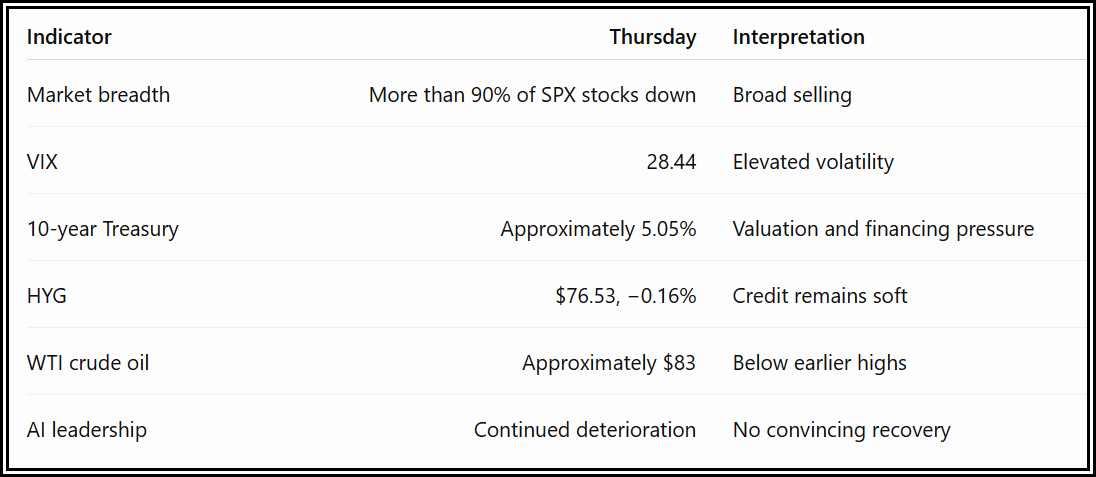
The most concerning combination is deteriorating breadth alongside elevated volatility and persistent weakness in former market leaders.
Credit deserves particular attention. A modest decline in HYG does not establish a credit crisis, but we don’t want to see high-yield bonds deteriorating significantly while equities attempt to recover.
The ideal improvement would include volatility retreating, credit stabilizing, and substantially better market breadth.
For now, the balance of evidence continues to favor capital preservation over aggressive risk-taking.
4. Where Opportunity Is Beginning to Appear
Even in a difficult market, some stocks are doing something interesting.
They’re refusing to participate in the general misery.
Palo Alto Networks (PANW) was Thursday’s standout example.
Shares gained 6.4% after the cybersecurity company reported fiscal first-quarter revenue growth of 39% to $3.44 billion, a 66% increase in next-generation security annual recurring revenue, and an improved full-year outlook.
CrowdStrike (CRWD) also finished higher.
That’s worth our attention.
When the market comes under sustained selling pressure, it becomes easier to identify the companies investors still want to own. Those pockets of relative strength can offer clues about where leadership may emerge when conditions improve.
Of course, one strong earnings reaction doesn’t establish a reliable buying opportunity.
For PANW, Thursday’s low near $350.52 and high near $370 provide useful short-term references. We want to see whether the stock can hold its gains, build a constructive pattern, and demonstrate continued accumulation as the market stabilizes.
This is a name to study, not a reason to abandon our market discipline.
Our focus should be on resilience, relative strength, improving price patterns, and identifiable risk levels. The biggest losers may eventually deliver spectacular percentage rebounds, but the best trades often emerge from the companies that held up while everyone else was struggling.
There’s a reason we look for strength before committing capital.
Cheap can become cheaper. Strong stocks, on the other hand, sometimes tell us where institutional demand is already beginning to return.
5. The Market’s Next Three Moves
We’ve reached the point where the next substantial rally could be especially informative.
Not because every sharp rebound is the beginning of a new uptrend, but because the market is now in a position where even modest improvement in buying pressure could produce a sizable recovery.
The distinction we need to make involves three separate developments.
First comes the bounce. Selling becomes sufficiently exhausted for buyers to overwhelm sellers temporarily. Prices jump, short sellers cover, and optimism returns.
Then comes stabilization. The indexes stop making progressively lower lows, begin defending important levels, and establish a sequence of higher lows.
Finally comes confirmation. Previously broken resistance is reclaimed, pullbacks find support, breadth improves, and new leadership begins to emerge.
Those events can unfold quickly, but they are not interchangeable.
A failed breakdown may produce an excellent trade without establishing a durable market bottom. We need to recognize the opportunity without assuming more than the evidence supports.
Here’s how we’re approaching the next several sessions.
Our Scenario Framework
Bullish scenario: Thursday’s lows hold, market breadth improves, and SPX and QQQ reclaim broken price levels, trapping bearish reversal plays in motion. The market develops higher lows followed by higher highs, with semiconductors and other leaders participating. Under those conditions, small initial positions become reasonable, followed by additions only as the recovery progresses.
Base scenario: Oversold conditions generate one or more sharp rallies, but selling returns near overhead neckline resistance. The indexes remain volatile while investors debate whether the correction has ended. We continue building watchlists and consider only exceptional setups with tightly defined risks.
Bearish scenario: Thursday’s lows fail, new lows expand, volatility increases, and rallies continue to attract selling. Additional downside becomes more likely, and preserving capital remains the appropriate response.
The market can move from one scenario to another quickly. Our responsibility is to recognize those transitions, not become emotionally attached to any particular outcome.
6. The Technical Decision Map
What would make us more constructive?
Stage 1: Stop the bleeding.
The indexes defend Thursday’s lows or briefly undercut them and reverse higher. Selling pressure begins diminishing, and new lows contract substantially.
This would be the first suggestion that sellers are losing some of their control.
Stage 2: Reclaim lost ground.
SPX recovers approximately 7,324 while QQQ reclaims $661. Importantly, the indexes don’t immediately surrender those recovered levels.
We begin looking for a higher low and evidence that buyers are willing to defend support.
This is where selective test positions could become attractive.
Stage 3: Confirm the change in character.
Strength begets more strength, instead of what we’ve been seeing - more selling.
The series of lower lows from lower highs is broken with higher lows and higher highs.
Previously broken price levels begin functioning as support, market breadth improves, and leadership reappears.
That’s when we can begin considering a more substantial increase in exposure.
The important point is that we don’t need all three stages to occur before initiating a trade. But the amount of risk we take should reflect the strength of the evidence available. Not to mention our stomach for risk and potential loss.
A small position with a defined stop is one thing. A large, aggressive position taken because the market looks beaten up or, even worse “cheap” is something else entirely.
We should never confuse these.
7. Friday’s Checklist: What Would Change Our Minds?
The next session carries several potential catalysts, including monthly options expiration and scheduled Federal Reserve appearances.
It is also the last trading day before the holiday season begins. A time in which markets tend to reflect the optimism and cheer instead of negativity and pessimism.
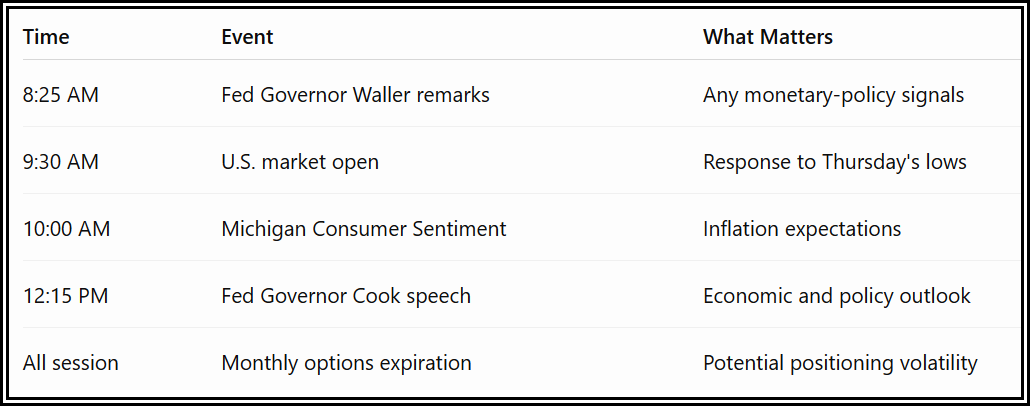
We also want to see how Anthropic behaves during its second session and whether the broader AI sector can begin stabilizing.
Our confirmation checklist is straightforward:
Price: SPX and QQQ defend Thursday’s lows and begin establishing higher lows.
Breadth: Declining stocks no longer overwhelm advancing stocks, and new lows contract sharply.
Leadership: Nvidia, semiconductors, and selected growth stocks stop deteriorating and begin outperforming.
Risk: VIX retreats while high-yield credit and Treasury yields stabilize.
Follow-through: Gains survive into the closing bell, and reclaimed support holds during subsequent selling pressure.
We don’t need every indicator to turn positive simultaneously. But we do need sufficient agreement among them to justify risking capital again.
One green opening won’t do it. Neither will a spectacular rally in a handful of beaten-down stocks.
The real test is what happens after buyers finally make their move.
Can they defend it?
8. The Opportunity in Waiting
There’s a temptation after a decline like this to believe that the market owes us a recovery.
After all, prices have fallen substantially. Many attractive companies are trading well below their recent highs. Pessimism is widespread. The ingredients for a sharp rally are certainly present.
But markets have an annoying habit of ignoring what investors think they deserve.
And they don’t award bonus points for being early.
The best opportunities often begin appearing before the broader market has completely recovered. We see them in relative-strength leaders, improving price-volume relationships, stocks defending higher lows, and companies whose shares begin responding favorably to good news again.
Those are the clues we’re looking for.
Our preparation should focus on identifying the businesses we want to own, determining where attractive entries might develop, and deciding in advance how much risk we’re willing to accept.
Then, when the market offers an opportunity, we’re not making decisions in the middle of the emotional chaos.
We’re executing decisions we’ve already considered carefully.
That is one of the great advantages of doing the difficult work when everyone else is focused on the latest headline.
Patience isn’t inactivity when we’re using the time to prepare. It’s positioning ourselves to act decisively when the odds finally improve.
The Bottom Line
Thursday told us that this correction isn’t finished proving itself.
Anthropic’s historic debut, strong operating results from selected companies, and the increasingly oversold condition of the market weren’t enough to overcome widespread selling pressure. The S&P 500’s nearly 240-point reversal from its high to the close was particularly revealing.
But we shouldn’t mistake the market’s current weakness for a guarantee of further declines.
Conditions are becoming stretched. The S&P 500 is currently the most oversold as it has been at the March 30th low this year and the March/April lows of 2025.
The possibility of a substantial rebound is increasing. And some companies are already showing the kind of relative strength that could make them attractive candidates when the market begins recovering.
That’s precisely why this is an important time to remain engaged, even while exercising restraint.
We don’t need to predict the bottom. We need to recognize when the price action begins shifting in our favor.
The next recovery attempt will provide another opportunity to examine the character of this market. Does selling pressure finally diminish? Do higher lows begin forming? Can the indexes reclaim resistance? Does leadership broaden? And, most importantly, can buyers defend the ground they’ve recovered?
When those answers become more favorable, we’ll have a reason to start taking risk again.
Until then, we’ll continue doing our homework, keeping our watchlists ready, and resisting the temptation to treat every declining stock as a bargain waiting to be discovered.
Because the goal isn’t to catch the very first uptick.
The goal is to be positioned for the next sustained advance without sacrificing our capital trying to predict every temporary bottom along the way.
And if that means allowing someone else to volunteer as the market’s crash-test dummy for a session or two, we can live with that.
The opportunities will come.
Our job is to be ready when they do.
Always your friend in good times and bad,
C.E. Kirk
“If you are not aggressive, you are not going to make money, and if you are not defensive, you are not going to keep money.”— Ray Dalio