
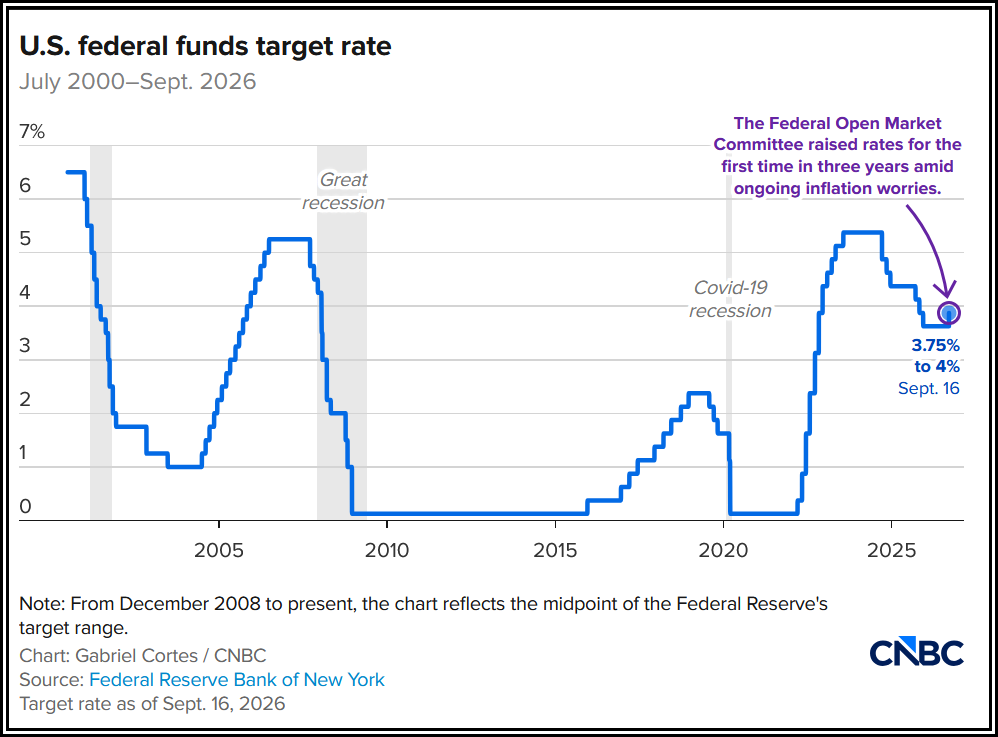
The Fed delivered the expected hike.
The surprise was how clearly it told investors not to assume it was done!
The question now is how stocks will handle not only the first Fed hike in three years, but the prospect of additional hikes ahead.
While the economy and earnings remain strong, we’re about to find out how well stocks can handle fighting a Fed refocused on taming inflation.
THE OPPORTUNITY
Having dropped 7 of the last 8 days, the S&P 500 closed below the June 2 high at 7620 for the third straight session.
Not only has the August breakout been successfully bull-trapped, but we’re now starting to see bearish follow-through.
The upper 196-point trading range has broken to the downside, putting the S&P 500 back into its May-June-July trading range. On a measured-move basis, subtracting 196 points from 7620 gives us a downside target of 7424.
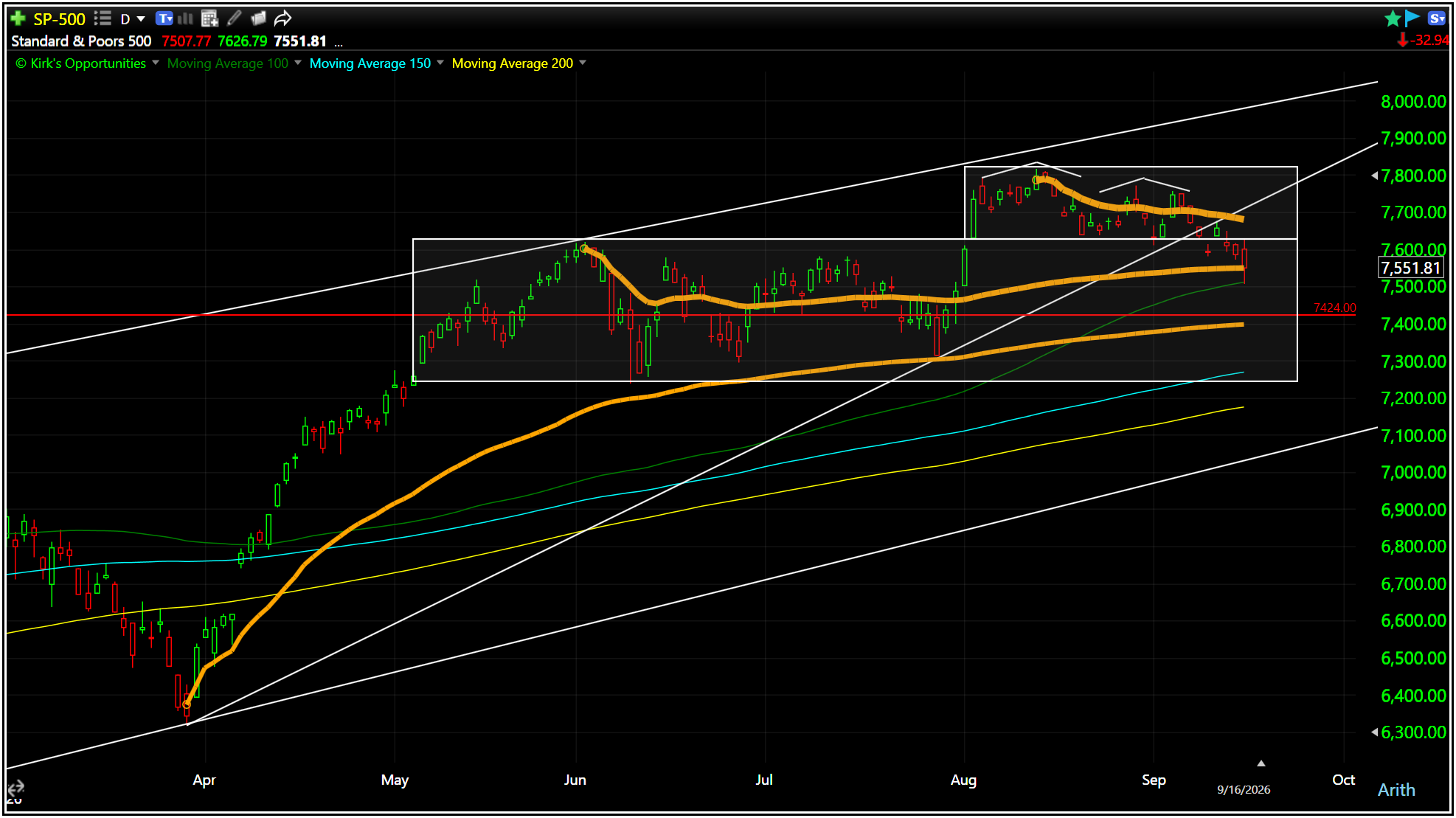
If reached, that would amount to roughly a 5% pullback from the mid-August high. That’s hardly extraordinary. We tend to see a 5% pullback about three times per year on average, and this would only be the second one this year.
There are several levels between here and there that matter.
With both the 21-day EMA and 50-day SMA now broken, the 100-day moving average at 7511 was tested and defended today. Below the 7424 measured-move target, the 150-day moving average sits near 7269, followed by the 200-day near 7174.
But while most investors focus heavily on moving averages, I pay much more attention to anchored VWAPs, particularly when they’re anchored to significant market turning points.
Today provided a good example. The S&P 500 rallied intraday to defend the 7550 AVWAP anchored to the June 2 high.
If that fails, the next major anchored VWAP below is around 7400, measured from the April 2 low. That’s especially interesting because it sits just below the 7424 measured-move target.
So we now have a potential cluster of support developing around 7400–7424 if the decline continues.
At the same time, given the steady weakness heading into today’s Fed decision, the possibility of an oversold relief rally still should not be entirely discounted. We’ll know much more by how we close on Friday.
THE TAPE
The S&P 500 fell 0.44% to 7552.14, but the modest headline decline understated the weakness underneath.
The Dow fell 1.21% and Russell 2000 lost roughly 0.4%. Nasdaq 100 finished essentially unchanged, while the FANG+ index slipped just 0.14%.
Breadth was considerably worse. Decliners beat advancers 1.75-to-1 on the NYSE and 1.48-to-1 on Nasdaq. The NYSE produced 430 new lows against 76 new highs, while Nasdaq had 257 new lows versus 51 new highs.
So selling broadened again but important growth leadership held up much better.
That distinction matters.
BENEATH THE SURFACE
One of the more constructive things I saw today was where the weakness wasn’t.
Nasdaq 100 closed up +0.3%, the FANG+ lost only 0.14%, and fallen angel Semiconductors (SMH) gained +0.64%.
Semiconductors had been at the center of the recent AI weakness, so seeing them stabilize while broader participation deteriorated is encouraging.
We now have a clear split: the average stock is weakening while several important growth and technology groups are holding up considerably better.
Either participation begins catching up, or eventually the remaining leaders get dragged lower.
For now, leadership is still resisting. Something we’ll be keeping a close eye on.
MIXER
Post-Fed reaction: Tomorrow may tell us more than today, and Friday will tell us even more than that. First, I want to see whether today’s weakness gets follow-through or buyers step in now that the first hike is behind us.
Rates: The 2-year jumped after the decision while the 10-year remained around 5%. That keeps valuation pressure alive.
Oil: Crude finally moved lower. More of that would remove one important source of inflation pressure.
Small caps: Russell 2000 continues lagging large-cap growth. A healthier market eventually needs broader participation.
Friday OPEX: A very large options expiration arrives Friday and is likely to increase volatility at a minimum. With the S&P 500 near important technical levels, positioning and expiration-related flows could exaggerate intraday moves.
Known negatives: Most of today’s and tomorrow’s challenges aren’t surprises anymore. The Fed is tightening. Yields are high. Inflation is sticky. Breadth is weak.
Investors have had plenty of time to worry about them.
So I keep asking: What happens when something finally starts going right?
Maybe oil keeps falling. Maybe yields back away from 5%. Maybe breadth improves. Maybe the Fed ultimately hikes less than feared.
When our screens stay red, it is easy to become consumed by what is going wrong.
Sure, I follow my stops and manage my risk, but I would rather be looking for what is starting to improve and where the next opportunity may be developing in spite of this weakness.
I’ve long thought that such over-focus on the Fed is a fruitless endeavor. Focusing on the Fed for so many years has taken my eyes off the ball than have helped them. Just a personal thought I have looked for an opportunity to share.
WORTH YOUR TIME
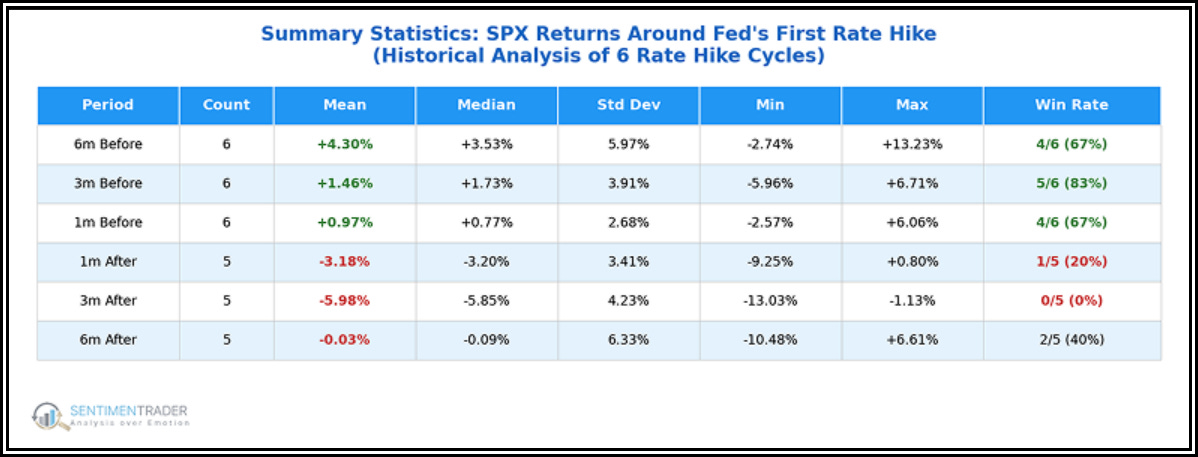
This study of first Fed rate hikes since 1994 from Sentimentrader.com shows stocks historically tending to struggle for 1 to 3 months after the initial hike followed by relatively weak returns in the months which have followed. Ugh.
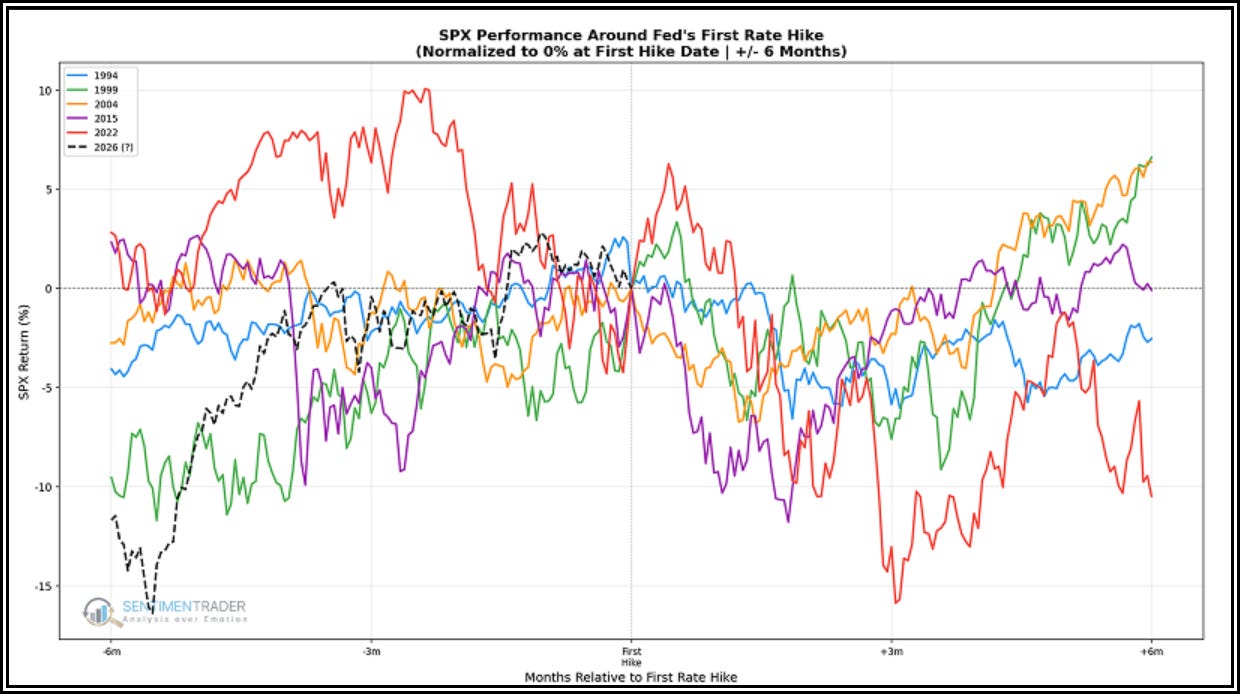
Yes, useful information.
But hardly secret information.
Everyone has heard “don’t fight the Fed.” Historical studies now circulate worldwide within minutes and can be summarized instantly by AI.
So the more interesting question is: How much of that expected weakness has already been anticipated and acted upon?
The answer, of course, is that we are going to find out!
Yet, investors were preparing for this tightening well before today’s announcement. The failed breakout, weaker breadth and recent selling suggest at least some of the historical post-hike concern has already been acted upon.
But markets trade on changes in expectations, not information everybody already knows.
If oil falls, yields retreat, breadth improves, or stocks simply stop reacting negatively to bad news, that may tell us more than the historical playbook.
In today’s information environment, the edge may come from watching what price does after everyone has already read the study.
YOUR TURN
Corrections make everything feel urgent, but they also reveal where strength remains.
When markets are under pressure, do you spend more time looking for what to sell—or looking for what may become the next opportunity?
I increasingly think the second question is far more productive.
TO TAKE WITH YOU
Corrections are uncomfortable, but revealing.
Use this one to identify what is holding up, what is improving, and what may become actionable next.
MEMBERS ONLY
One stock has been doing exactly what I want to see during this pullback—holding up better than the market and many of its competitors.
I think that relative strength is now good enough to entertain an initial position.