


There is something wonderfully reassuring about sitting in cash when the stock market is falling apart.
The headlines are dreadful. Stocks are getting clobbered. Investors are panicking. And there we are, watching the commotion from a comfortable distance, feeling rather pleased that we decided to step aside before things got ugly.
Then something annoying happens.
The market starts going up.
Not a little, either. Stocks that looked like they needed emergency medical attention suddenly jump 8%, 15%, sometimes over 20% in a single session.
The financial commentators who were explaining why we should be terrified are now discussing the possibility of a spectacular recovery. The same stocks nobody wanted last Thursday are apparently irresistible by Wednesday.
And that comfortable cash position?
Suddenly, it doesn’t feel quite so comfortable.
Welcome to one of investing’s great psychological challenges: knowing when to get back in after successfully getting out.
The Other Half of Capital Preservation
After three decades of active investing, I’ve learned that getting defensive and becoming aggressive again require two very different mindsets.
Recently, I moved my actively managed trading portfolio entirely into cash. The technical damage, selling pressure, and deterioration in leadership had become too substantial to ignore.
That decision was about protecting capital.
But selling is only half the equation.
We know that some of the stocks getting hammered will eventually become outstanding opportunities. We know that markets have a history of recovering, often when pessimism is greatest. And we know that waiting until everything looks wonderful again can mean missing a considerable portion of the advance.
What we don’t know is whether the rally unfolding in front of us is the beginning of a lasting recovery or merely another temporary interruption in a larger decline.
Unfortunately, the market doesn’t send invitations announcing when it’s safe to return. There isn’t a customer service department we can call, either.
We’re on our own.
That’s why I’ve come to believe that reentering the market should be a process rather than a prediction.
We don’t have to identify the exact bottom. We need to recognize when the evidence has improved enough to make taking risk worthwhile again.
The First Rally Can Be Deceptive
One of the more frustrating characteristics of corrections is that some of the most impressive rallies occur when conditions remain terrible.
That’s often precisely why they happen.
After a sharp decline, investors have reduced exposure. Short sellers have increased their bets. Leveraged traders have been forced to liquidate. Eventually, selling pressure becomes exhausted.
Then a little buying arrives.
Short sellers scramble to cover. Traders who sold near the lows rush to get back in. Momentum algorithms join the festivities.
Suddenly, stocks are flying higher, and everyone wants to know whether the bottom is in.
Sometimes it is.
Other times, we’ve merely witnessed a spectacular demonstration of what happens when everyone tries to squeeze through the same exit in reverse.
The problem is that both situations can look remarkably similar at first.
A powerful rally tells us buyers have returned. It doesn’t necessarily tell us they’re prepared to stay.
That’s why I’m less interested in the initial excitement than in what follows.
Does the market hold its gains? Do buyers defend higher levels? Do leading stocks continue outperforming when the indexes pull back?
Or does everything begin falling apart the moment sellers decide to give it another try?
The first rally gets our attention. What happens next helps determine whether it deserves our money.
Three Questions That Matter Most
When evaluating a potential recovery, I focus on three pieces of evidence.
1. Is the market beginning to behave differently?
During a correction, rallies repeatedly fail. Support levels break. Stocks that appear to be recovering suddenly reverse and make new lows.
Eventually, that behavior may begin changing.
The indexes establish higher lows. Pullbacks become shallower. Important support levels hold. Disappointing news produces less downside than it did previously.
In other words, selling stops working quite as well.
I also want to know what’s happening beneath the indexes. Are more stocks reclaiming their 50-day moving averages? Are new lows contracting? Is the equal-weight S&P 500 improving? Are credit markets remaining orderly?
We don’t need every indicator flashing green, but we do want evidence that buyers are gradually regaining control.
The most encouraging development isn’t necessarily that prices are rising. It’s that they’re becoming harder to push lower.
That’s what attracts my attention.
2. Are the right stocks leading?
The S&P 500 can rally while the stocks we actually want to own continue struggling.
Conversely, some individual stocks begin demonstrating exceptional strength before the broader indexes look particularly healthy.
That’s why I spend so much time studying relative strength, trading volume, moving averages, and constructive price patterns.
Which stocks held up best during the selloff? Which are reclaiming important technical levels? Which are developing tight consolidations instead of experiencing wild, erratic rebounds?
Consider two hypothetical stocks.
Stock A has declined 40% and just rebounded 15%. That sounds exciting, but it’s still down 31% from its original level.
Stock B declined only 8%, held its 50-day moving average, and is now approaching a potential breakout while outperforming the market.
Which one interests me more?
Usually, Stock B.
Its resilience suggests sustained demand, and its technical structure may offer a better way to define risk.
This distinction is especially important in technology and semiconductors, where spectacular rebounds can develop long before the damage has been repaired.
A stock can jump 12% in two sessions and still be trapped beneath declining moving averages, overhead resistance, and a large supply of unhappy shareholders waiting to sell.
Sometimes that’s an opportunity.
Other times, it’s simply a stock having a very good couple of days in an otherwise miserable month.
The strongest stocks often distinguish themselves by how little damage they suffer when everything else is falling apart.
That’s where I prefer to look first.
3. Is the market rewarding our actual purchases?
This might be the most underrated confirmation signal of all.
We can analyze the S&P 500, Nasdaq-100, market breadth, Treasury yields, credit spreads, and every indicator under the sun.
But eventually, we have to place an actual trade.
Suppose we identify three promising setups and begin taking small positions. One immediately fails. Another struggles to hold support. The third briefly breaks out before reversing sharply.
Perhaps our timing is premature. Perhaps leadership remains unstable. Whatever the reason, the market isn’t rewarding our efforts.
Now imagine a different situation.
Our initial purchases hold their entry levels. Pullbacks attract buyers. Relative strength continues improving. Several positions begin developing healthy gains.
That’s evidence worth respecting.
One of the best reasons to increase our market exposure is that our existing positions are giving us a reason to do so.
I like that arrangement.
The market does the proving. We provide the capital.
My Re-Entry Playbook
Here’s how I intend to translate those observations into actual decisions.
First, prepare before the opportunity arrives.
I want our shopping list ready while the market is still sorting itself out.
That means identifying stocks with strong relative strength, constructive technical setups, and clear potential entry points.
It also means knowing which candidates are extended, which are repairing damage, and which are approaching actionable levels.
Waiting until everything is racing higher to decide what to buy is a wonderful way to end up owning whatever happens to be moving the fastest.
I’ve tried that approach over the years.
Let’s just say it hasn’t earned a permanent place in my investment playbook.
Second, make the first purchase a test.
I don’t need to go from completely defensive to fully invested because the market had two encouraging sessions.
A modest initial position allows us to participate without making an enormous commitment to an uncertain recovery.
If it works, we can evaluate adding. If it fails, the damage should be manageable.
The initial purchase isn’t a declaration that we’ve solved the market.
It’s an experiment with a predefined cost.
Third, know exactly where the trade is wrong.
Before entering, I want to identify the price level that would invalidate the setup.
For a stock emerging from a tight consolidation, that might be just below its most recent relevant low.
Suppose we’re considering a purchase at $100 with a protective stop at $95.
If we’re willing to risk $250 on that particular trade, the initial position would be 50 shares, assuming execution at the stop price. Stops aren’t guaranteed execution prices, and gaps or slippage can result in larger losses.
Simple arithmetic, but an important principle: our acceptable loss should determine our position size, not our enthusiasm.
If the distance to a sensible stop makes the potential loss unacceptable, we either reduce the position or pass.
And if there isn’t a logical place to exit, I’m probably not interested.
Finally, let success justify additional exposure.
If an initial position holds support, builds a gain, and continues outperforming, we can consider increasing it. If other leading stocks are behaving similarly, we might gradually expand our overall exposure.
But we also have to accept that our first attempts may fail.
We can make a perfectly reasonable purchase, manage our risk correctly, get stopped out, and still watch the stock eventually begin a tremendous advance.
Sometimes we have to buy the same stock more than once before catching a sustained move.
That’s not necessarily poor trading. It’s often the cost of participating in an uncertain transition.
The objective isn’t to be right on our first attempt. It’s to make sure we’re still in the game when the right opportunity finally arrives.
And if that means buying back a stock at a slightly higher price, so be it.
There’s no trophy for buying the exact bottom.
I’ve looked.
What Would Change My Mind?
Rather than making one grand prediction about where the market is headed, I prefer to prepare for three possible paths.
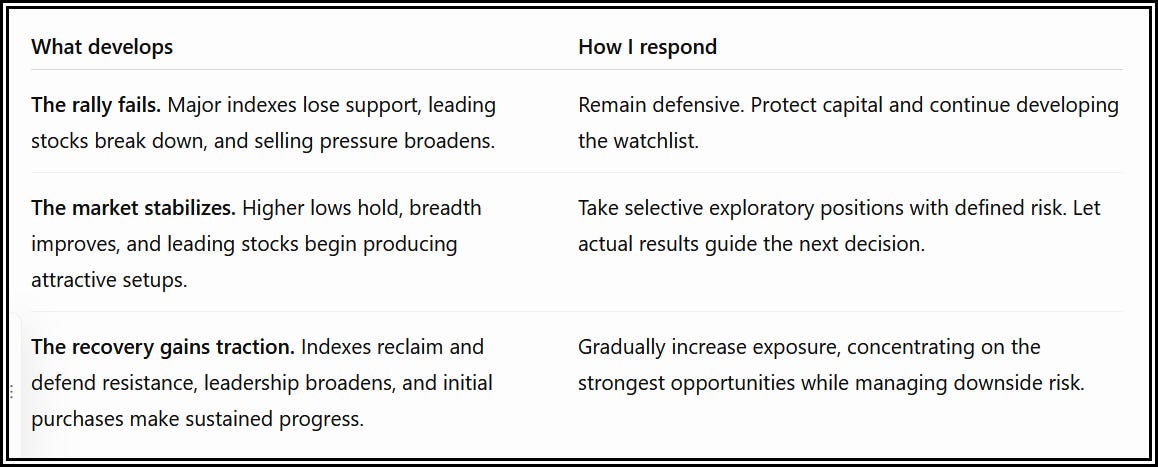
Notice that none of these scenarios requires knowing exactly where the market will be next week or next month.
They simply establish what evidence would cause us to change our positioning.
That’s a much more manageable task than predicting the market’s next 500-point move.
The Hidden Danger of Being Right
There’s another complication here, and it has very little to do with charts.
Sometimes the hardest part of returning to the market is that we were right to get out.
Think about that for a moment.
When we successfully avoid a significant decline, we feel good about our decision. As we should.
But there’s a subtle psychological trap waiting for us.
We become attached to being right.
We start looking for reasons why every rally might fail. We notice every bearish headline, every technical warning, every analyst predicting additional trouble.
Perhaps Treasury yields are too high. Perhaps earnings expectations are unrealistic. Perhaps the economy is slowing.
There will always be reasons to worry.
And some of them will be entirely legitimate.
But markets don’t wait for uncertainty to disappear before recovering. Some of the best opportunities develop while the headlines remain thoroughly unpleasant.
A defensive decision that was correct last week doesn’t automatically remain correct next week.
It’s a little like refusing to take off your raincoat because you were absolutely correct about yesterday’s thunderstorm. Congratulations. You were right about the weather.
But the sun is out now.
Of course, the market equivalent of sunshine can disappear rather quickly. That’s why we manage risk rather than assuming every change in conditions will last.
The broader point is that our previous decisions shouldn’t prevent us from recognizing new opportunities.
Our job isn’t to defend our earlier opinions. It’s to make the best decisions we can with the evidence available now.
If that evidence changes, we should be willing to change our minds.
That’s not inconsistency.
That’s adaptability.
And after all these years, I consider adaptability one of the most valuable skills an investor can develop.
The Bottom Line
I remain encouraged by the possibility that the recent market correction will eventually create some very attractive opportunities.
That’s one of the reasons I’ve been so focused on protecting capital. Having money available when opportunities develop is an enormous advantage.
But available capital doesn’t help much if we become too reluctant to deploy it.
Cash gives us the freedom to wait. Discipline gives us the confidence to act. Successful investing requires knowing when to use each.
For now, I’m watching whether selling pressure continues to fade, whether leadership improves, and whether attractive setups begin producing sustainable gains.
If the evidence supports increasing exposure, I’ll be willing to do so. If it deteriorates, there’s no reason to force the issue. After all, protecting capital is important, but it isn’t the ultimate objective.
We’re protecting our ability to take advantage of the next great opportunity.
There’s no prize for buying the exact bottom, and no shame in paying a little more once the evidence improves.
The real mistake isn’t missing the first few percentage points of a recovery. It’s allowing the fear of being wrong to prevent us from acting when the odds finally shift in our favor.
“People are not rational. They are rationalizing. Once you understand this simple fact, all the oddest human behavior will suddenly make way more sense.” - Billy Markus