

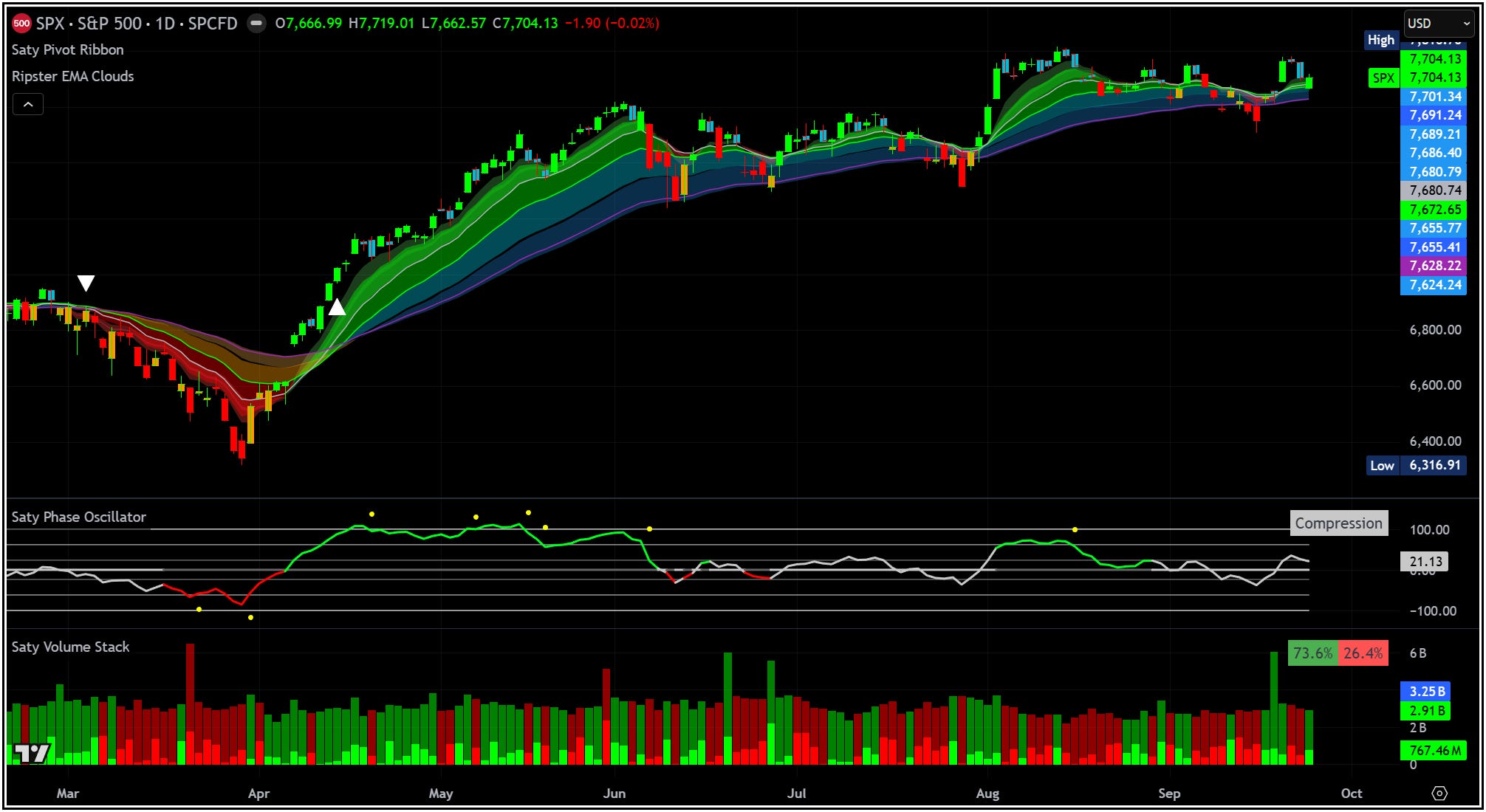
Thursday, September 24, 2026 | Kirk’s Opportunities
There is no shortage of pressure on this market.
Higher Treasury yields, elevated energy costs, and weak participation are giving investors plenty to worry about. Yet the major indexes remain comparatively resilient. The weakness beneath the surface has not translated into a decisive breakdown at the top.
Prices are holding relatively firm despite the pressure being applied to them.
The S&P 500 has partially retraced Monday’s opening gap without completely filling it.
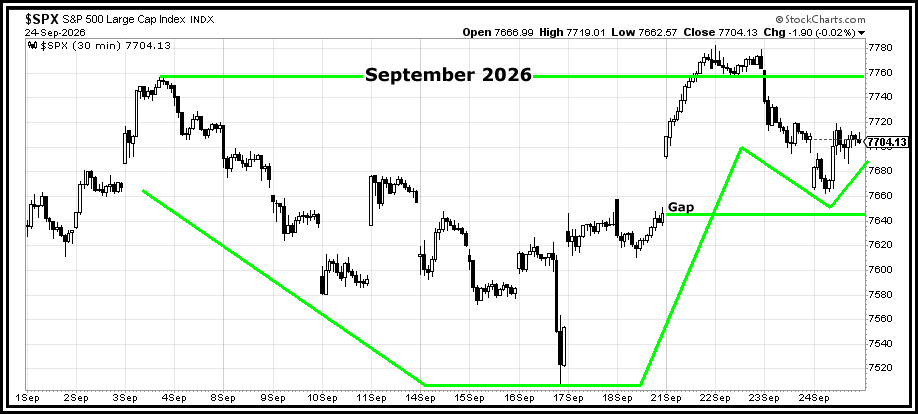
Price also tested the 21-day exponential moving average area and closed above it.
Those are useful reference points for judging whether this is a pullback within a constructive structure or the beginning of something more damaging.
Neither the gap nor the moving average is magical. What matters is whether buyers continue defending this area and whether more stocks eventually join them.
For now, we should resist two temptations: dismissing the warning signs because the indexes have not broken, and assuming a breakdown must follow because the warning signs are numerous.
Respect the pressure. Respect the price. Do not confuse either with certainty.
MARKET CLOSE
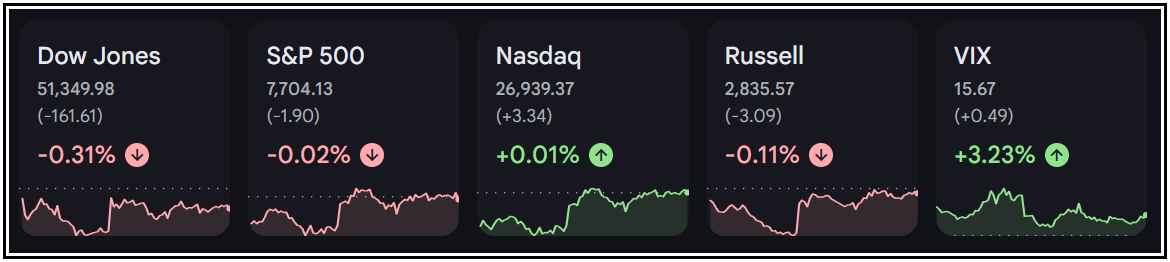
S&P 500: 7704.13: −0.02%.
Nasdaq Composite: 26939.37: +0.01%.
Nasdaq 100: 30478.86: +0.03%.
Dow Jones Industrial Average: 51349.98: −0.31%.
Russell 2000: 2835.57: −0.11%.
S&P MidCap 400: 3637.83: −0.41%.
The closing percentages barely moved. The session was considerably more eventful than those numbers suggest.
MONEY FLOW
Communication services led, gaining approximately 1.9%, followed by healthcare at 0.7% and energy at 0.4%. Technology recovered from its early weakness but still finished slightly lower. Materials, utilities, and consumer staples each lost approximately 1%, while industrials declined 0.7%.
This was not a simple rotation into safety. Traditional defensive sectors did not automatically provide protection, and technology did not move as one block.
Biotech also deserves attention. The Nasdaq Biotechnology ETF gained approximately 1.3%, while regional banks recovered, with KRE gaining approximately 0.8%. That was an important exception to the broader pressure we have been monitoring in rate-sensitive businesses.
Use sector themes to organize the research—not to override what individual stocks are doing.
BENEATH THE SURFACE
Thursday’s recovery did not repair participation.
Declining stocks still outnumbered advancing stocks by nearly two to one on the NYSE and roughly three to two on Nasdaq. New 52-week lows substantially exceeded new highs. That is a much weaker picture than the nearly unchanged major indexes suggest.
Two observations can be true at the same time: the major indexes are holding together, while many individual stocks remain under pressure. Additionally, a number of high-yield ETFs have reached 52-week lows, but credit spreads were only around where they stood a week earlier. Falling bond prices are therefore not, by themselves, proof of an accelerating credit crisis.
We should keep watching HYG while distinguishing pressure from higher Treasury yields from a deterioration in the extra compensation investors demand for credit risk.
Caution remains justified. A more severe conclusion requires stronger evidence.
THE MACRO CHAIN GETS TESTED
Oil → Inflation → Fed → Yields → Valuations → Breadth → Price.
Reports of discussions around a phased reopening of the Strait of Hormuz helped stocks recover from their morning weakness. Those were reports of negotiations—not confirmation that an agreement had been completed or shipping conditions normalized.
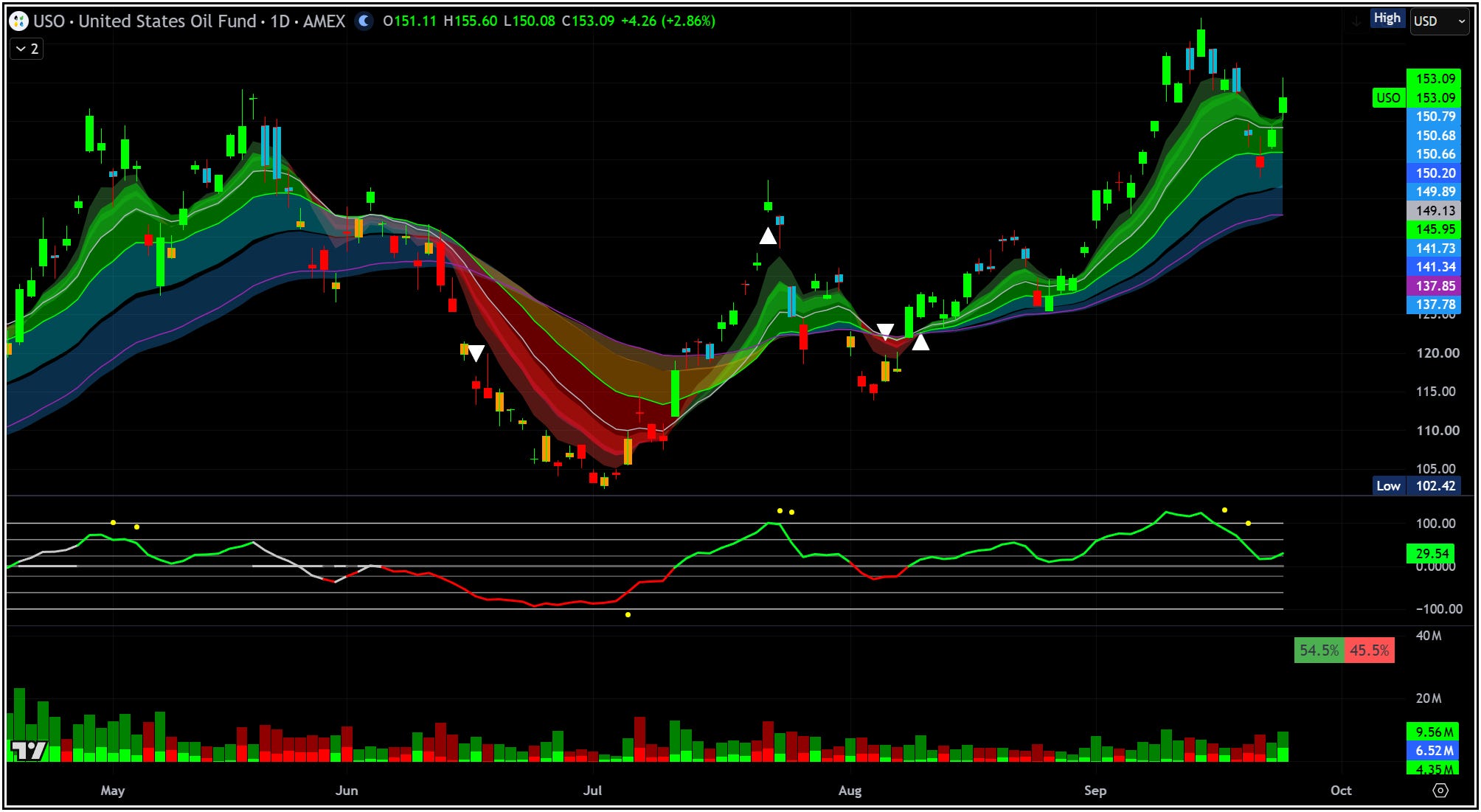
Oil’s retreat from its intraday high was helpful, but the distinction matters: WTI still settled higher on the day, gaining approximately 2.4% to $94.68. A retreat from the high was not the same thing as the energy problem disappearing.
Treasuries offered less relief. A soft seven-year auction contributed to renewed selling, and the 10-year yield finished around 5.16%.
Our working interpretation remains that 5%+ yields are separating the market rather than simply sinking it.
That makes our investment filter especially important:
Own businesses capable of growing profits faster than the pressure created by higher rates.
We want strong earnings growth, cash generation, pricing power, durable competitive advantages, and expanding markets—not simply an attractive theme.
That does not make valuation irrelevant. A strong business can still become a poor investment when the entry price assumes too much.
RISK DASHBOARD
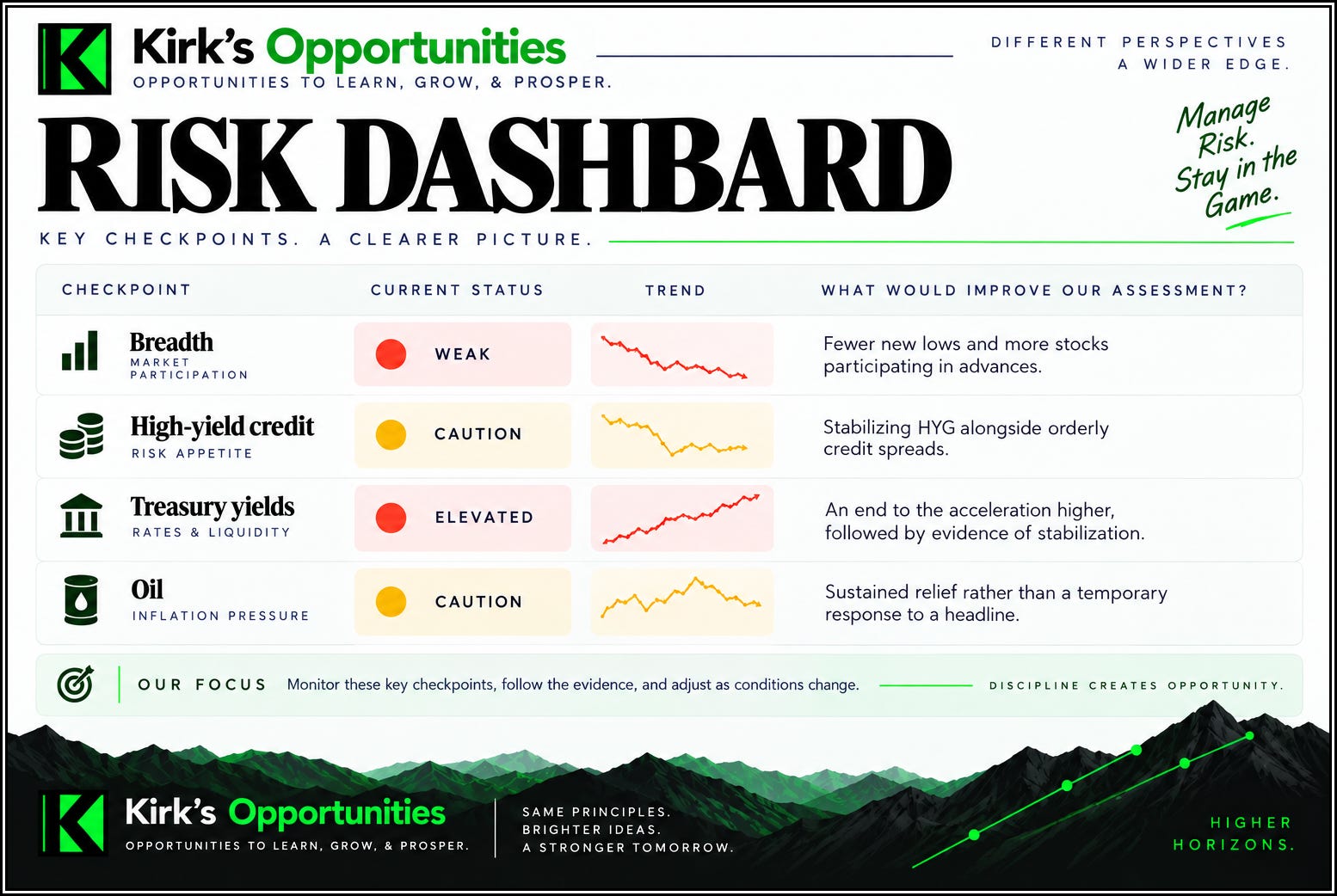
Overall: flashing caution, with selective opportunities—not a blanket instruction to buy or sell.
IMPORTANT STOCK MOVES
Meta Platforms (META): +4.50%. Continued enthusiasm around Muse and its potential monetization helped the stock reach a new year-to-date high. Investors are rewarding the company-specific growth story despite the rate backdrop. Expectations are rising alongside the share price.
Advanced Micro Devices (AMD): +2.38%. AMD recovered from its early weakness and finished near the session high. The strength was notable as we see this as an opportunity worth pursuing.
Hewlett Packard Enterprise (HPE): +1.91%. HPE reached a fresh 52-week high during the session, although it surrendered part of that advance before the close. Holding subsequent pullbacks would strengthen the relative-strength case.
Moderna (MRNA): +6.98%. MRNA’s advance, alongside Eli Lilly’s 2.85% gain, helped healthcare provide leadership outside the largest technology stocks. The next test is whether that strength becomes more sustained and widespread.
Oracle (ORCL): −3.48%. Reports involving a force-majeure notice at a New Mexico data-center project put construction and delivery risk back in focus. Strong AI demand does not eliminate the practical challenges of meeting it.
AI: DEMAND STILL HAS TO BECOME CASH FLOW
Nscale’s IPO disclosures offer a useful illustration.
The company reported approximately $103.4 billion in active and contracted total contract value, but only $2.6 billion was attached to active contracts. Neither figure represents current annual revenue. Revenue for the six months through June was approximately $140.6 million, while the net loss was approximately $1.02 billion. Much of the future opportunity still depends on financing and delivering the infrastructure. (The Register)
Those figures do not prove the business cannot succeed. They show why we should not treat a contract announcement, an operating data center, recognized revenue, and shareholder cash flow as interchangeable.
For our research, the chain is:
Demand → Financing → Power → Permitting → Construction → Deployment → Return on invested capital.
A bottleneck anywhere along that chain can delay the economics.
The better question is not, “How big is the AI opportunity?”
It is, “How much of that opportunity can this business convert into durable cash flow—and what are we paying for it?”
MIXER
The AI Shopping Fight Is About Access. Amazon’s move to block Muse contrasts with Shopify’s welcome for Meta’s shopping agent. The investment question extends beyond which assistant becomes popular: when an agent handles discovery and checkout, who retains the customer relationship—and who gets paid? (The Wall Street Journal)
More Agents, More Identities to Control. Okta’s latest announcements extend its security framework toward identifying agents, controlling permissions, monitoring activity, and cutting off access when something goes wrong. Some capabilities are available now; expanded runtime kill-switch functionality remains planned. The opportunity is more autonomous activity that enterprises must govern. (Okta)
Big Tobacco still finding ways to win. Did you know Altria (MO) and Philip Morris (PM) are up more than 20% year-to-date and have price structures pointing for additional gains? The FDA is expected to announce in coming days that it will revisit its rules to speed up the authorization process, people familiar with the matter said. These possible changes are most important for newer products, such as vapes and nicotine pouches. (WSJ)
Costco Gives Us a Fresh Consumer Check. Costco’s after-hours results showed quarterly net sales rising 11.2% and comparable sales increasing 6.7% after excluding gasoline-price and currency effects. Reported earnings of $6.75 per share included a $0.15 nonrecurring benefit. Friday’s stock reaction will help show whether those operating results are sufficient for investors’ expectations. (Costco)
Mark Minervini Lays The Groundwork: According to today’s tweet, “this remains a highly bifurcated and selective market. The major capitalization-weighted indexes can give the appearance of broad strength even while a significant portion of the market is behaving considerably worse underneath. Until breadth improves, new highs expand, and leadership broadens beyond a concentrated group of names, I would continue to treat the strength in the headline indexes with a degree of skepticism and caution.”
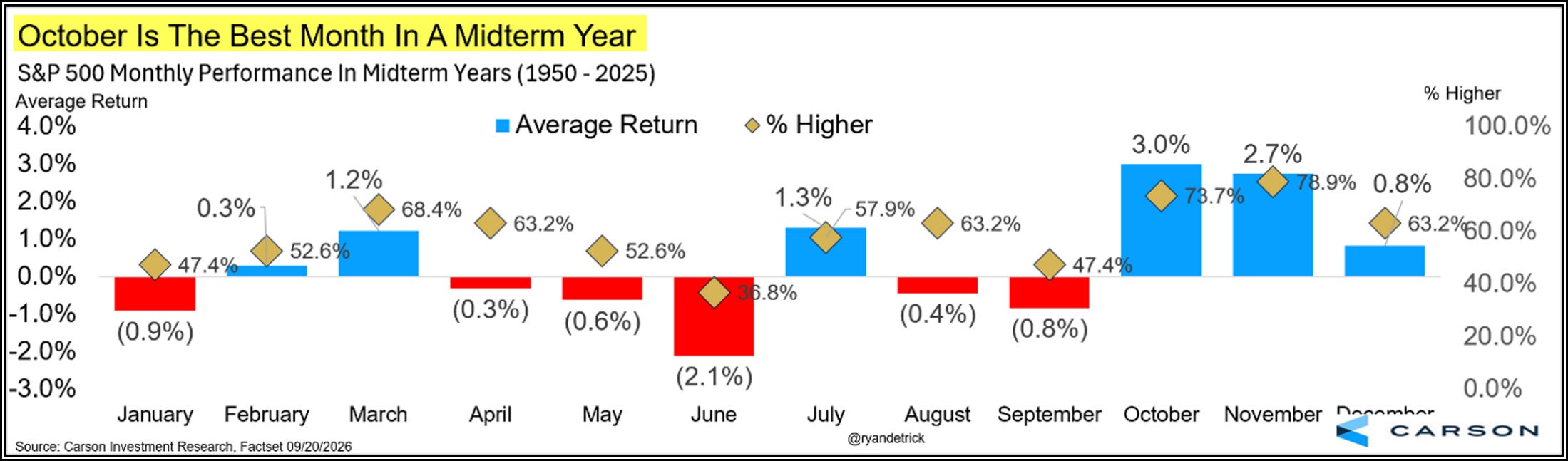
Disruption of the status quo? Those who prefer the status quo are likely feeling a wee bit anxious these days. The US mid-term elections on November 3rd are fast approaching and, at this point, the Democrats are expected to take the control of the House and even the Senate. However, there is still October left, and the chance for the Republicans to improve their chances of retaining at least of control of the Senate. Thus, some have argued the Republicans may need to conjure up an “October surprise” to block a blue sweep. (MSN)
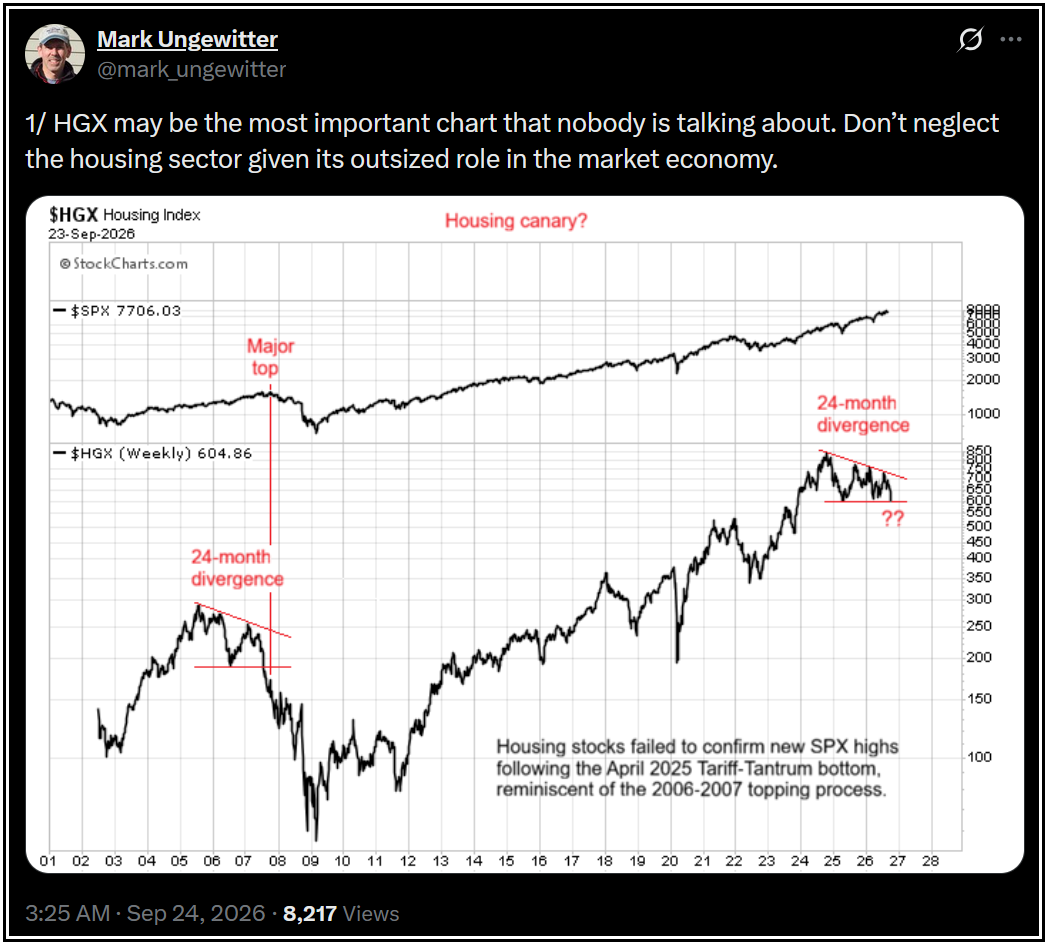
Be Careful What You Wish For! We all want more affordable housing, but as stock investors, we need to watch how we get there. Improving affordability through rising incomes and greater supply is one thing. Getting there because housing is cracking under economic pressure is another. As the always-astute Mark Ungewitter warns today, this is not a bullish divergence for stocks. When housing cracks, hold on to your @$$.
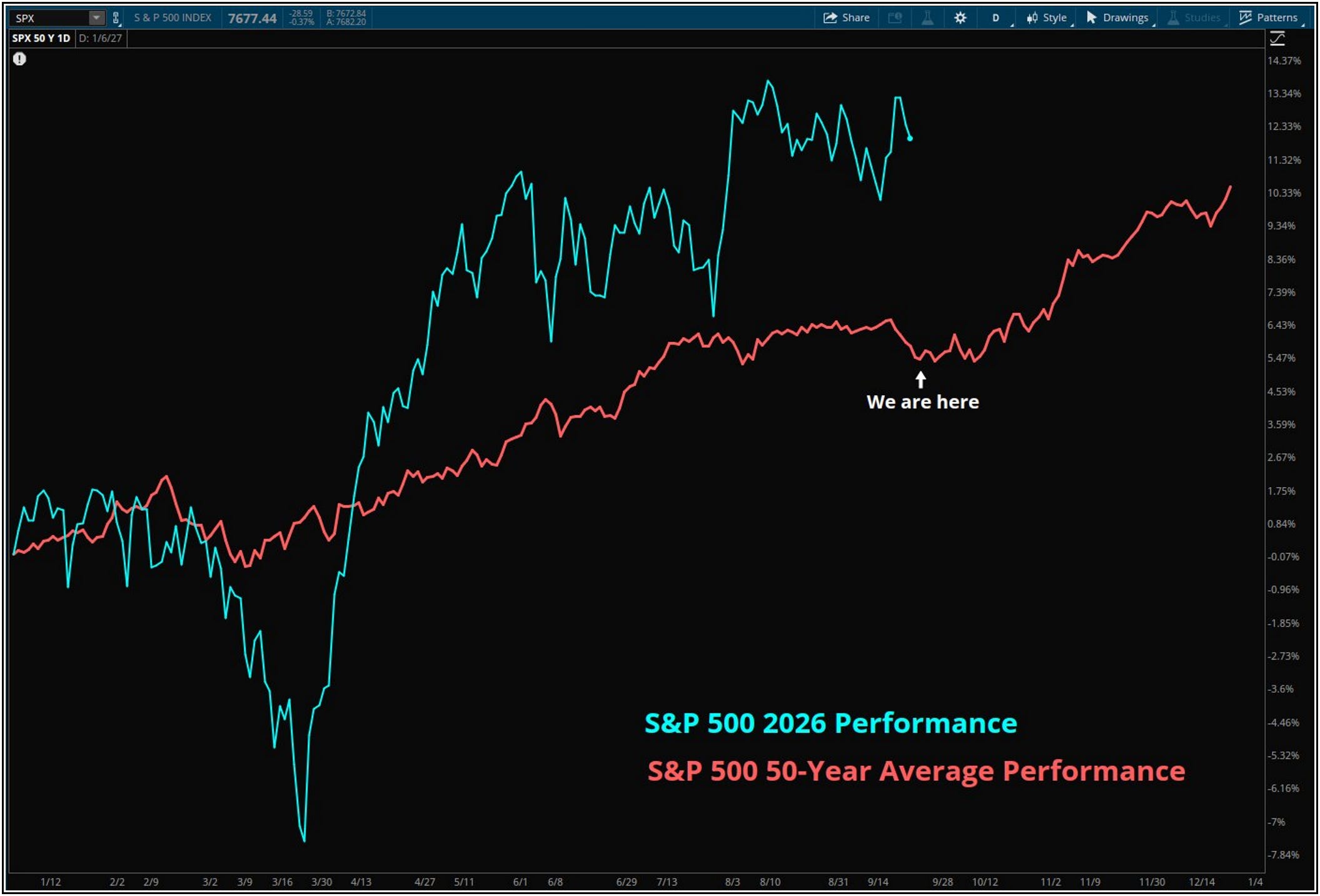
The September Low Is Already In? Based on $SPX 50-year average annual returns, the calendar is approaching an area that has historically marked a seasonal low before a stronger finish to the year. (via Rachel Dashiell)
The AI Stock-Picking Test Starts Here. Our six-system comparison begins with today’s closing prices. Each ten-stock hypothetical portfolio starts equally weighted and remains unchanged through December 31, with no rebalancing or substitutions. Returns will include reinvested dividends and stock-split adjustments, excluding fees and taxes. Below, I explain why tracking the agreement among these systems interests me as much as tracking their performance. (Six AI Systems. Sixty Stock Picks.)
